
Marks to CGPA Calculator
Convert your subject marks to CGPA
Subject Marks
Your CGPA Results
Grade Scale Reference
In today’s fast-paced academic environment, students and professionals often come across the terms marks, grades, GPA, and CGPA. With educational institutions in India and abroad shifting toward grading systems, the importance of an accurate marks to CGPA calculator has grown exponentially. Whether you are a school student, a college aspirant, or a working professional seeking higher education overseas, understanding how to convert marks into CGPA is crucial. Beyond just numbers, this system has significant implications for regional education frameworks, state-level implementation, rural development, women empowerment, and broader social welfare initiatives.
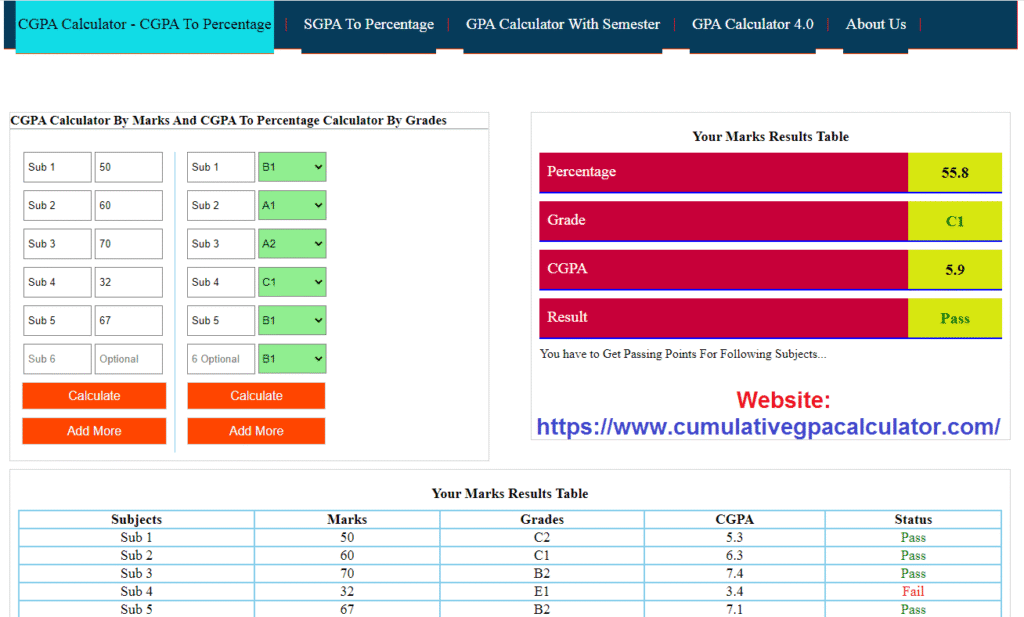
This article takes you through a comprehensive journey—covering the history, objectives, methodology, state-wise impact, success stories, challenges, and future prospects of the marks to CGPA calculator.
Understanding the Basics: Marks, GPA, and CGPA
What are Marks?
Marks are the traditional way of evaluating a student’s academic performance. They represent raw scores obtained in examinations and assessments. While transparent and straightforward, marks often fail to reflect the holistic performance of a student, especially in diverse and competency-based learning environments.
What is GPA?
The Grade Point Average (GPA) is a system that converts marks into a standardized numerical value. GPA ranges (for example, 0 to 10 or 0 to 4 depending on the institution) provide a uniform way to compare student performance across subjects and institutions.
What is CGPA?
The Cumulative Grade Point Average (CGPA) is an overall measure of academic performance across multiple subjects or semesters. It reflects not just individual subject performance but also cumulative achievement.
Why Convert Marks to CGPA?
The marks to CGPA calculator is essential because:
- Different universities adopt varying grading systems.
- International universities often require CGPA scores instead of marks.
- Employers, scholarship bodies, and exchange programs rely on CGPA for assessing applicants.
- It provides a simplified, stress-free evaluation model for students.
Historical Background of the Grading System
India traditionally relied on marks as the sole determinant of academic success. This often led to unhealthy competition, pressure, and the marginalization of students who performed well but not exceptionally in exams.
In 2009, the Central Board of Secondary Education (CBSE) introduced the grading system and marks to CGPA conversion model for classes IX and X. The aim was to reduce academic pressure, promote conceptual learning, and align with global standards.
Other boards such as ICSE, state boards, and higher education bodies gradually started adopting variations of GPA and CGPA systems. With increasing globalization, Indian institutions began adopting calculators that easily convert marks into CGPA for international acceptability.
Objectives of a Marks to CGPA Calculator
The marks to CGPA calculator is not merely a tool—it reflects a shift in educational policy and pedagogy. Its objectives include:
- Standardization – Providing a common framework for comparing performance across institutions.
- Stress Reduction – Minimizing the stigma attached to low marks by converting them into grades.
- Global Mobility – Helping students apply seamlessly to international institutions.
- Inclusivity – Allowing students from rural, marginalized, and underprivileged backgrounds to compete on equal grounds.
- Transparency – Eliminating subjectivity and regional disparities in marks evaluation.
How Does a Marks to CGPA Calculator Work?
The calculator typically works on a straightforward formula:
CGPA = (Sum of Grade Points in all Subjects) ÷ (Total Number of Subjects)
To convert CGPA into percentage, the formula is:
Percentage = CGPA × 9.5 (as per CBSE standards)
For example, if a student secures a CGPA of 8.4, their percentage is:
8.4 × 9.5 = 79.8%.
Different boards and universities may use slightly modified formulas, but the underlying principle remains similar.
Regional and State-Level Impact
The adoption of CGPA and marks to CGPA calculators has varied across states in India.
- Southern States (Tamil Nadu, Karnataka, Kerala): Widely accepted the grading system to align with international standards, especially due to high student migration for higher studies.
- Northern States (Delhi, Punjab, Haryana): Strong CBSE presence ensured smooth adoption.
- Eastern and North-Eastern States: Gradual implementation with additional state-specific guidelines.
- Rural Areas: Awareness campaigns and teacher training programs were introduced to help students and parents understand the transition from marks to CGPA.
This state-level adoption has contributed to reducing exam-related stress and ensuring broader inclusivity.
Role in Women Empowerment and Rural Development
The marks to CGPA calculator has indirectly contributed to women empowerment and rural development in India.
- Women Empowerment: Many girls, especially in rural and semi-urban areas, faced discouragement due to average marks. The CGPA system allowed them to showcase competence without being confined to rigid scores, encouraging higher participation in education.
- Rural Development: In rural schools, where teaching standards vary, grading ensures that students are not unfairly penalized. It encourages them to pursue higher studies and vocational training with confidence.
Such inclusive frameworks are aligned with national policies like Beti Bachao Beti Padhao and Digital India, promoting accessibility and equity in education.
Social Welfare Initiatives Linked to the Calculator
The marks to CGPA calculator is also linked to broader social welfare goals:
- Scholarships: Many government and NGO scholarships require CGPA scores for eligibility.
- Skill Development: Grading fosters confidence, motivating students to enroll in skill programs.
- Employment Opportunities: With CGPA becoming a recognized evaluation metric, employers in both private and public sectors find it easier to shortlist candidates.
Implementation Challenges
Despite its advantages, the transition from marks to CGPA has faced several challenges:
- Lack of Awareness – Parents and students in rural regions often misunderstand CGPA, assuming it diminishes meritocracy.
- Variations Across Boards – Different boards use different formulas, leading to confusion.
- Global Comparisons – While helpful, CGPA conversion may not always match international grading systems accurately.
- Teacher Training – Inadequate training sometimes leads to inconsistent grade allocation.
- Resistance to Change – Many traditionalists still prefer marks over grades.
Success Stories and Positive Outcomes
Several case studies demonstrate how marks to CGPA calculators have transformed education:
- Delhi Government Schools: Students reported reduced exam stress and greater participation in extracurricular activities after CGPA adoption.
- Kerala’s Rural Schools: Girls’ enrollment in higher studies improved due to confidence instilled by the grading system.
- North-Eastern States: Scholarships and exchange programs became more accessible once standardized CGPA conversion tools were introduced.
Comparison with Other Systems
Percentage System vs CGPA
- Percentage: Offers precision but often causes stress.
- CGPA: Encourages overall development but may lack detailed differentiation.
International GPA Systems
- US: GPA on a 4.0 scale.
- Europe: ECTS grading system.
- India: Mostly 10-point CGPA system.
The marks to CGPA calculator bridges these systems, enabling students to translate their achievements globally.
Future Prospects of Marks to CGPA Calculators
The future of CGPA conversion looks promising:
- AI-Based Calculators: Smarter, automated, and board-specific tools will minimize errors.
- Integration with Digital Education Platforms: National Digital University and e-learning portals will integrate CGPA calculators for seamless use.
- Policy Frameworks: NEP 2020 emphasizes flexible and competency-based education, which aligns well with grading systems.
- Regional Inclusivity: More vernacular tools will be developed to help rural and non-English-speaking populations.
Marks to CGPA Calculator and the National Education Policy (NEP) 2020
The NEP 2020 emphasizes holistic, multidisciplinary education. The marks to CGPA calculator supports this by shifting focus from rote learning to competency. By reducing dependency on marks, the system encourages creativity, problem-solving, and innovation among students—skills that are crucial for India’s socio-economic development.
Frequently Asked Questions (FAQs)
Conclusion
The marks to CGPA calculator is far more than a mathematical tool—it represents a paradigm shift in India’s education system. By aligning with global practices, reducing exam stress, empowering women, and supporting rural development, it plays a crucial role in shaping the future of learning. Despite challenges, its long-term benefits in terms of inclusivity, mobility, and holistic development are undeniable. With advancements in technology and supportive policy frameworks, the marks to CGPA calculator is set to become an indispensable component of modern education.