
SPPU CGPA to Percentage Calculator
Convert your CGPA to percentage instantly
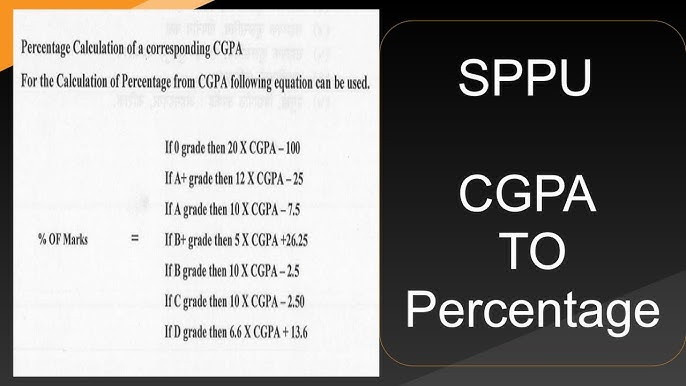
As per SPPU conversion formula
In a world where grades translate into opportunity, understanding how academic scores convert from one system to another is crucial. The SPPU CGPA to percentage calculator has become an essential tool for thousands of students graduating from Savitribai Phule Pune University and affiliated colleges. This in-depth article explains what the calculator does, why it exists, how it’s implemented, and what it means for students, institutions, and regional education policy. Whether you are a student trying to evaluate your academic standing, an admissions officer assessing applications, or a policymaker examining equity between grading systems, this guide equips you with practical knowledge, historical context, comparisons, case studies, and a forward-looking perspective.
Understanding the Basics: What is the SPPU CGPA to Percentage Calculator?
Savitribai Phule Pune University (SPPU) uses a Cumulative Grade Point Average (CGPA) system for many of its programs. While CGPA provides a normalized measure of performance across courses and credits, many employers, other universities, and some government processes still prefer percentage marks. The SPPU CGPA to percentage calculator is a method — often implemented as an online tool — to translate CGPA scores into percentage equivalents.
At its core, the calculator applies a conversion formula approved by the university or follows an accepted convention to convert the CGPA scale (commonly 10-point) into the percentage scale (0–100%). Students use the SPPU CGPA to percentage calculator to prepare transcripts, apply for higher education, or meet job application criteria that require percentages.
Why Conversion Matters: Objectives and Necessity
The shift toward CGPA was driven by pedagogical goals: to reduce grade inflation, reward holistic learning, and facilitate credit-based mobility. However, the coexistence of CGPA and percentage systems led to several practical challenges:
- Interoperability: Different institutions use different grading systems. A robust SPPU CGPA to percentage calculator ensures SPPU graduates can be fairly compared with peers from percentage-based institutions.
- Admissions and Recruitment: Many national competitive exams, scholarship programs, and employers still ask for percentages. Conversion tools bridge that gap.
- Transparency: A well-documented conversion method increases transparency and trust in academic assessment.
- Record Keeping: Standardized conversion assists university registrars and affiliated colleges in issuing transcripts and certificates that meet external criteria.
Thus, the SPPU CGPA to percentage calculator serves the objective of making student records universally interpretable without eroding the pedagogical benefits of CGPA.
A Brief History: How SPPU Adopted CGPA and the Emergence of Conversion Tools
The CGPA system traces back to global trends in higher education, which favored credit-based evaluation and the European Credit Transfer and Accumulation System (ECTS) model. Indian universities, including SPPU, started experimenting with semester systems and CGPA to align with international practices and to emphasize continuous assessment.
However, as more institutions adopted CGPA, the need for reliable conversion surfaced. Initially, simple heuristics—such as multiplying CGPA by 10—were used informally. Over time, institutions realized that such heuristics lacked nuance, especially across diverse programs and grading distributions. This catalyzed the development of more accurate SPPU CGPA to percentage calculator implementations, often accompanied by official conversion policies issued by examination departments.
How the Calculator Works: Formulae and Methodologies
Different universities and departments may endorse distinct conversion approaches. Common methods include:
- Linear Multiplication: The most common simple method is Percentage = CGPA × 10. This is straightforward and widely used, but it assumes scale linearity across the board.
- Adjusted Linear Method: To better reflect academic distributions, some calculators use Percentage = (CGPA – offset) × scale, where offset and scale are calibrated to historical grade distributions.
- Weighted Conversion: For programs with varied credit weights across courses, the calculator computes weighted averages before converting using a chosen formula.
- Statistical Mapping: Sophisticated approaches map CGPA percentiles to percentage distributions using historical exam data, providing a conversion that aligns with previous cohorts.
The SPPU CGPA to percentage calculator frequently implements either the straightforward multiplication rule or an adjusted variant approved by the university. Students should verify the university’s official guidance, especially when applying for scholarships or regulated processes.
Implementation: From Paper to an Online Tool
Implementation of a conversion mechanism involves several stakeholders: the examination department, IT services, colleges, and sometimes the university senate. Typical steps include:
- Policy Approval: A conversion policy is drafted and approved, specifying the formula and scope (undergraduate, postgraduate, professional programs).
- IT Integration: The university’s student information system (SIS) incorporates the SPPU CGPA to percentage calculator logic to auto-generate transcripts and marksheets.
- User Interface: An online calculator is often provided on the university website or via affiliated college portals for students to perform quick conversions.
- Documentation: Detailed FAQs and policy documents explain the rationale, exceptions, and effective date of the conversion formula.
Widespread adoption also depends on training registrars and faculty to ensure that the SPPU CGPA to percentage calculator is used consistently.
State-Level and Regional Impact: Maharashtra and Beyond
SPPU, based in Maharashtra, plays a substantial role in regional higher education. The adoption and standardization of the SPPU CGPA to percentage calculator has several ripple effects:
- Equitable Assessment: A standardized conversion reduces regional disparities when students apply for state-level fellowships or employment.
- Administrative Consistency: Colleges affiliated with SPPU benefit from clear guidelines that streamline administrative tasks and reduce errors in issuing certificates.
- Inter-University Mobility: Students seeking transfers or higher studies outside Maharashtra can more easily have their records recognized.
- Public Policy Alignment: State education departments may use consistent conversion practices when assessing university performance or allocating grants.
The SPPU CGPA to percentage calculator influences not just individual students but also broader educational policy, academic mobility, and administrative coherence across the state.
Success Stories: Real-World Benefits of Reliable Conversion
Several success stories illustrate how accurate conversion tools transform academic and professional trajectories:
- Smooth Admissions: Students applying to national-level institutes found that standardized conversion removed ambiguity during the admissions process, ensuring fair evaluation.
- Scholarship Access: Scholarship committees that require percentages could assess SPPU students objectively when transcripts included percentage equivalents computed by an official SPPU CGPA to percentage calculator.
- Placement Outcomes: Employers that screen candidates by percentage could more accurately shortlist SPPU graduates, leading to higher placement rates for deserving students.
- International Recognition: Some foreign universities accept percentage-based evaluations more readily; a validated conversion process made international applications more straightforward for SPPU alumni.
These anecdotes demonstrate that beyond arithmetic, conversion tools hold practical value in opening opportunities.
Challenges and Criticisms
No conversion method is flawless. Implementing an SPPU CGPA to percentage calculator invites several objections and operational challenges:
- Loss of Granularity: CGPA represents cumulative performance across different pedagogical formats. Reducing it to percentage may oversimplify nuanced evaluation outcomes.
- Inconsistent Scales: Different programs may have different grading rigor, making a single conversion formula imperfect across disciplines.
- Perception Issues: Some stakeholders may distrust conversion formulas, perceiving them as arbitrary or favoring certain cohorts.
- Transition Confusion: When universities change conversion policies, old and new conversions may both appear on records, causing confusion during verification.
- Policy Coordination: Aligning university-level conversion rules with state and national regulations requires administrative effort.
Addressing these challenges requires transparency in methodology, clear documentation, and responsive grievance mechanisms.
Comparisons with Other Universities and Systems
Comparing SPPU’s practices to other universities reveals both commonalities and divergences:
- Multiplication by Ten: Many Indian universities endorse the simple CGPA × 10 rule. While simple, this approach lacks nuance and may not reflect disciplinary differences.
- University-Specific Adjustments: Some institutions, particularly technical universities or central universities, publish conversion tables based on historical grade distributions.
- International Equivalents: Globally, CGPA conversions often use percentile-based mapping to align with grade point averages in the U.S., ECTS in Europe, or national qualification frameworks.
- Automated Transcripts: Progressive universities integrate conversion directly into digital transcripts, ensuring consistent usage across applications.
The SPPU CGPA to percentage calculator should be situated within this spectrum: offering clarity and utility while acknowledging that alternative methods may offer greater statistical sophistication.
Best Practices for Students Using an SPPU CGPA to Percentage Calculator
Students should adopt several best practices to ensure accurate interpretation of their academic records:
- Verify Official Policy: Always consult SPPU’s official circulars or registrar’s office to confirm the approved conversion formula.
- Document Dates: If a conversion policy changed during your enrollment, note the effective date on your applications.
- Use Official Tools: Prefer university-provided calculators or official transcript conversions for high-stakes applications.
- Retain Original Records: Keep copies of university mark sheets and CGPA transcripts; these are critical if verification is required.
- Explain, if Needed: When applying externally, include a short note explaining the conversion method used, especially for scholarship or employment forms.
Careful record-keeping and use of official conversion tools will reduce disputes and streamline application processes.
Technical Walkthrough: How to Use the Calculator (Practical Example)
To make the concept concrete, here is a practical, generalized example of how an SPPU CGPA to percentage calculator might be used:
- Input CGPA: Enter your cumulative CGPA (for example, 7.8).
- Choose Program/Year (if applicable): If the calculator accounts for program-specific adjustments, select your program.
- Apply Formula: If the university uses the simple rule, the calculator computes 7.8 × 10 = 78%.
- View Results: The result is displayed along with explanatory notes and links to the official policy.
- Download Certificate: Some systems allow you to generate a PDF copy of the converted mark for inclusion in applications.
This simple user flow underlines why many students find the SPPU CGPA to percentage calculator convenient and reliable for everyday needs.
Administrative Perspectives: How Universities Manage Conversion
From the administrative point of view, the conversion tool must be robust, auditable, and integrated with record-keeping workflows. Key administrative concerns include:
- Audit Trails: Every conversion used for official documents should be logged with timestamps, user IDs, and method version.
- Version Control: Conversion policy versions must be tracked to prevent confusion between cohorts.
- Accessibility: The SPPU CGPA to percentage calculator should be accessible on the university portal with adequate security and uptime.
- Training: Staff in affiliated colleges must be trained to interpret and explain conversion outputs.
Good governance in these areas reduces disputes and builds confidence in the conversion process.
Policy Framework and Legal Considerations
Conversion from CGPA to percentage can have legal and regulatory implications:
- Regulatory Compliance: Some scholarship or governmental schemes stipulate percentage criteria; the conversion must align with such legal requirements.
- Equity: Policies must be equitable, avoiding systemic biases that disadvantage particular programs or demographic groups.
- Transparency: Universities should publish conversion formulas, explanatory examples, and the rationale to minimize legal challenges.
- Data Privacy: As calculators often process student data, universities must adhere to data protection norms and avoid unnecessary sharing.
Embedding the SPPU CGPA to percentage calculator within a sound policy framework reduces institutional risk and enhances student trust.
Social and Economic Impacts: Beyond Numbers
Conversion tools affect more than admissions and placements; they intersect with broader social outcomes:
- Access to Opportunities: For first-generation college students, clear conversion practices expand access to scholarships and jobs.
- Regional Development: As educational credentials become more portable, regions like Pune benefit from a more mobile and employable workforce.
- Gender and Inclusion: Transparent conversions can mitigate subjective biases in evaluation, supporting initiatives like women empowerment schemes that rely on academic merit.
While a calculator is a technical instrument, its ripple effects touch policy, equity, and regional development.
Challenges in Practice: Real-World Complications
Operational realities can complicate conversion:
- Data Entry Errors: Incorrect CGPA input can lead to wrong percentage outputs on official forms.
- Affiliated College Variances: Colleges affiliated with SPPU may follow slightly different internal grading practices, complicating uniform conversion.
- International Applications: Some foreign institutions insist on original grade point scales or re-evaluation by credential assessment bodies.
- Legacy Records: Older records may use a different grading system, requiring retroactive conversions with clear documentation.
Addressing these requires institutional vigilance, student awareness, and continuous auditing of conversion workflows.
Comparisons with Alternative Approaches: Pros and Cons
When evaluating conversion strategies, consider these trade-offs:
- Simple Multiplication (CGPA × 10):
- Pros: Easy to implement, consistent.
- Cons: May not reflect grading rigor across disciplines.
- Statistical Mapping:
- Pros: More accurate alignment with historical distributions.
- Cons: Requires robust datasets and statistical expertise.
- Program-Specific Tables:
- Pros: Tailored conversions per discipline.
- Cons: Complex to maintain and may confuse stakeholders.
Universities must balance simplicity against fairness. The SPPU CGPA to percentage calculator often opts for a pragmatic approach that favors transparency and consistency.
Future Prospects: Where Conversion Practices Are Headed
As higher education modernizes, conversion practices will evolve:
- Dynamic Conversion Algorithms: Machine-learning methods could map CGPA to comparative outcomes, improving fairness across disciplines.
- International Standardization: Broader adoption of global frameworks like ECTS may reduce the need for ad hoc conversions.
- Blockchain Transcripts: Secure, verifiable digital transcripts could embed both CGPA and percentage equivalents with immutable audit trails.
- Policy Harmonization: State and national bodies may issue standard conversion guidelines to streamline mobility.
SPPU and other universities will likely combine technological upgrades with policy harmonization to make the SPPU CGPA to percentage calculator more accurate, trustworthy, and future-ready.
Practical Tips for Employers and Administrators Assessing Converted Scores
When reviewing converted percentages, employers and administrators should:
- Request Originals: Always verify original CGPA transcripts along with converted percentages.
- Check Versioning: Confirm which conversion policy or tool generated the percentage and whether it corresponds to the student’s cohort.
- Contextualize Performance: Consider course rigor, elective choices, and departmental grading norms to interpret converted percentages fairly.
- Use Percentiles: Whenever possible, supplement converted percentages with percentile ranks for better comparisons.
Responsible interpretation avoids misjudging candidates based solely on converted figures.
Building an Effective University Converter: Technical and UX Considerations
Creating a user-friendly SPPU CGPA to percentage calculator involves:
- Clear Input Validation: Ensure CGPA inputs are within plausible ranges and provide helpful error messages.
- Explanatory Notes: Display the formula and a short explanation alongside the result.
- Downloadable Proof: Allow students to download a stamped, time-stamped conversion certificate for applications.
- Mobile Responsiveness: Many students access services via mobile; make the tool responsive.
- API Access: Provide secure API endpoints for authorized institutional use (e.g., employers verifying results).
A well-designed tool enhances utility and trust.
Case Studies: How Conversion Helped Real Students (Anonymized)
Case Study 1: A final-year engineering student used the official SPPU CGPA to percentage calculator to compute her final percentage for a national scholarship. The conversion was accepted without contest, enabling her to secure a merit-based fellowship.
Case Study 2: An arts graduate applying to a European university included both her original CGPA and the percentage computed by SPPU’s official calculator. The foreign admissions office appreciated the clarity and processed her application faster.
These anonymized examples illustrate the practical value of reliable conversion.
Recommendations for Policy Makers and University Leaders
To maximize the benefits of conversion tools, policymakers and leaders should:
- Publish Clear Policies: Release official conversion formulas and examples in multiple languages.
- Standardize Across Affiliates: Encourage affiliated colleges to adopt standardized grading practices to ease conversion.
- Invest in IT: Fund robust digital infrastructure for secure, auditable conversions.
- Engage Stakeholders: Consult students, faculty, employers, and regulators when revising conversion methods.
- Monitor Outcomes: Regularly evaluate how conversion policies affect admissions, placements, and scholarship distribution.
Proactive stewardship ensures that the SPPU CGPA to percentage calculator serves educational equity and institutional credibility.
Ethical Considerations and Fairness
Conversion tools must be used ethically:
- Avoid Manipulation: Policies should prevent gaming or retroactive adjustment of conversions to favor specific groups.
- Ensure Accessibility: Tools and documentation must be accessible to students with disabilities and those lacking digital access.
- Maintain Confidentiality: Protect student data processed during conversions.
Ethical practices strengthen the legitimacy of converted scores.
How to Verify an SPPU CGPA to Percentage Conversion
Verification steps commonly include:
- Obtain Original Transcripts: Request original CGPA transcripts bearing signatures and university seals.
- Check Conversion Policy: Verify the conversion formula was applied according to the university’s policy for the student’s cohort.
- Cross-Reference with Registrar: For high-stakes cases, contact the registrar’s office for official certification.
- Use Secure Portals: If available, use university verification portals or APIs to confirm values.
These steps ensure that percentage values used in decisions are accurate and official.
Frequently Asked Questions
Conclusion
The SPPU CGPA to percentage calculator is more than a mathematical tool — it is a bridge linking pedagogical practice to real-world requirements. As higher education in India modernizes, reliable conversion methods safeguard student mobility, support equitable assessment, and enhance institutional accountability. Students, administrators, and policymakers all benefit from clear policies, robust technical implementations, and ongoing dialogue about fairness and transparency.
For SPPU graduates, understanding the mechanics and implications of the SPPU CGPA to percentage calculator empowers them to present their achievements accurately and with confidence. For institutions, maintaining a credible, auditable, and user-friendly conversion process builds trust and facilitates smoother transitions across the educational landscape.