
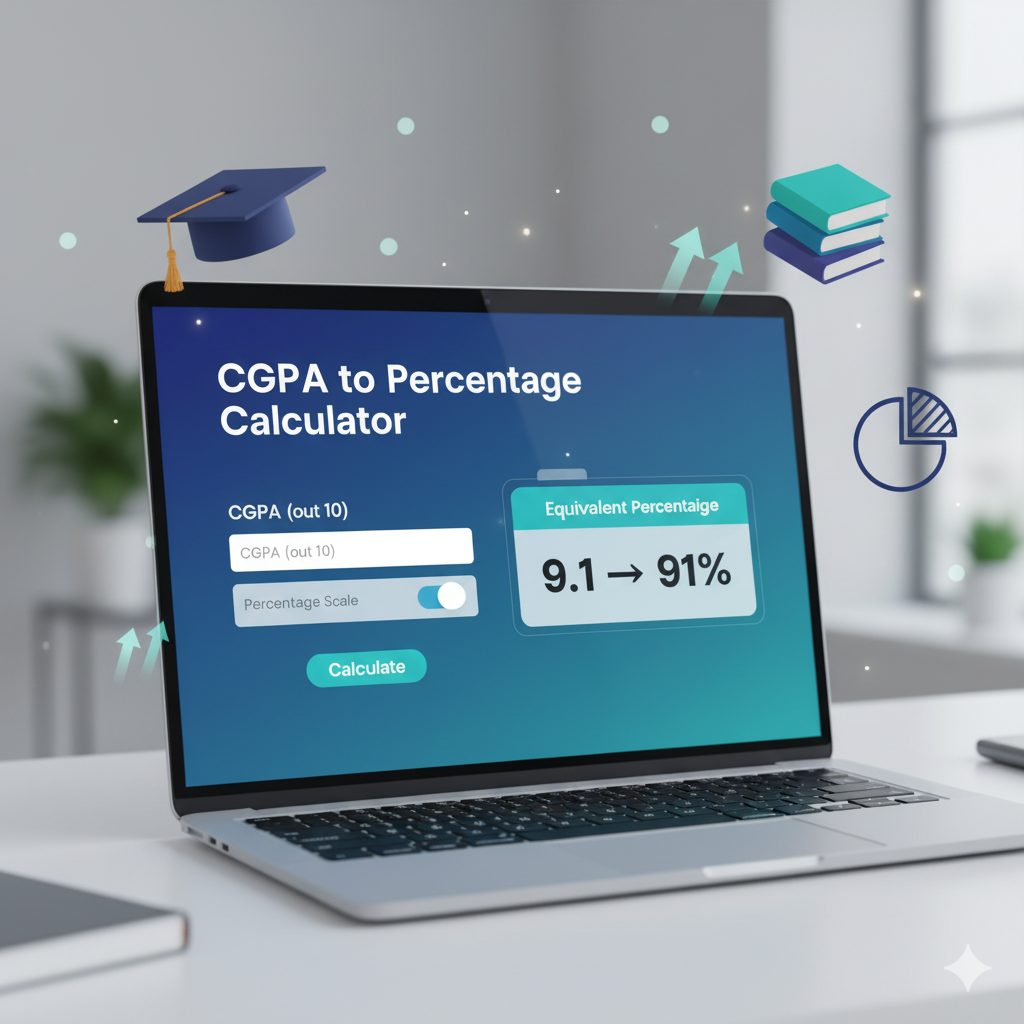
CGPA to Percentage Calculator
Convert your CGPA to percentage based on your university’s formula
Conversion Results
Different universities use different conversion formulas. Always check with your institution for the exact formula.
Converting CGPA to percentage is a routine yet crucial need for students, employers, and academic institutions. Whether you are applying for higher studies, scholarships, jobs, or state-level schemes, understanding how a cgpa to percentage calculator works can save time and remove ambiguity. This article offers an in-depth, authoritative exploration of the topic, covering history, objectives, methodologies, implementation across boards and universities, regional impact, success stories, challenges, comparisons with other systems, and future prospects. Throughout, the term cgpa to percentage calculator appears naturally and frequently so the article is both SEO-optimized and usable in practical decision-making.
Why conversion matters: the objective behind a cgpa to percentage calculator
Academic evaluations are more than numbers: they determine eligibility for scholarships, state-sponsored education benefits, employment shortlists, and professional licensure. Many boards and universities use Cumulative Grade Point Average (CGPA) systems to normalize performance across subjects and semesters. However, scholarship committees, employers, and other educational institutions often require percentages. A reliable cgpa to percentage calculator provides a standard, transparent bridge between these two representations of academic achievement.
Students and policymakers depend on the conversion for fairness and comparability. A transparent cgpa to percentage calculator reduces disputes during admissions and recruitment, enabling policymakers to design equitable programs and states to allocate resources efficiently. It also supports social welfare initiatives—especially when schemes target students from rural areas or marginalized groups—by ensuring that eligibility thresholds translate clearly across grading systems.
A short history of grading systems and the rise of CGPA
Grading systems have evolved from simple marks (percentage-based) to more complex grade-point systems. Historically, education systems relied on raw marks and percentages because they were easy to compute and understand. Over time, educational institutions adopted grade systems to reduce subjectivity, minimize extreme score clustering, and compare students across different cohorts and curricula.
The CGPA system became popular as universities and boards sought to:
- Smooth out variability among evaluators.
- Standardize performance across diverse subjects.
- Simplify multi-semester performance into a single, digestible metric.
With CGPA now widespread, the need for a cgpa to percentage calculator emerged organically. Different universities and boards developed conversion rules—sometimes officially sanctioned, sometimes unofficial—leading to a landscape where a single student could be judged differently depending on which conversion rule an employer or institution uses. This inconsistency is exactly why a reliable and well-documented cgpa to percentage calculator is indispensable.
How a cgpa to percentage calculator works: methodologies explained
There is no single universal formula for converting CGPA to percentage; various boards and universities use different scales and multipliers. However, most cgpa to percentage calculator implementations rely on a few standard approaches:
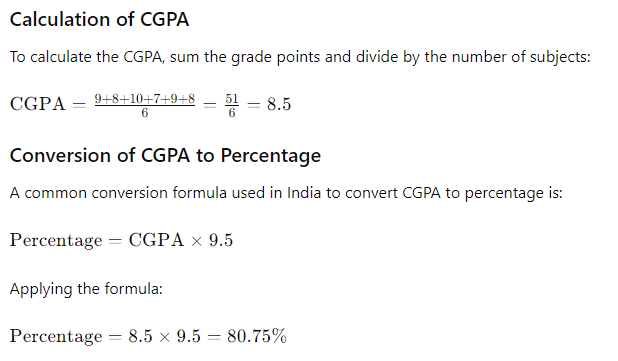
- Linear multiplier method: Multiply the CGPA by a fixed number (for example, 9.5 or 10) to get a percentage. Several Indian universities and national boards have used the multiplier method—commonly CGPA × 9.5—based on historical normalization data.
- Scale mapping method: Map CGPA ranges to percentage ranges. For instance, a CGPA of 8.0–8.9 might map to 80–89%. This mapping can be non-linear and considers grade boundaries.
- Weighted component method: Convert each semester’s grade point to percentage using a board-specific rule and then compute a weighted average. This method is more precise when credits per course differ.
- Statistical normalization method: Use cohort statistics—mean and standard deviation—to convert CGPA into a percentile or corresponding percentage. This approach is often used for large-scale comparative analyses.
A practical cgpa to percentage calculator will often let you select the conversion rule (multiplier, mapping table, or weighted average) and, if necessary, input credit distributions. Choosing the correct method depends on the institution or purpose for which the conversion is being used—scholarships, admissions, or state benefits may each prefer a specific method.
Step-by-step: using a cgpa to percentage calculator
A simple and transparent cgpa to percentage calculator should follow these steps:
First, identify the conversion policy required by the receiving institution (employer, university, scholarship body, or governmental department). If the receiving party has an official rule—such as “multiply CGPA by 9.5″—use that.
Second, collect accurate inputs. For a simple multiplier, you only need the final CGPA. For weighted conversions, gather semester GPAs, credit weights, and subject-level grade points.
Third, perform the calculation. For example:
- With a linear multiplier: Percentage = CGPA × Multiplier (e.g., 9.5).
- With weighted components: Percentage = (Sum of (grade point × credits × multiplier)) / (Total credits).
Fourth, round as required. Many institutions specify rounding rules—nearest integer, two decimal places, or truncation. A robust cgpa to percentage calculator includes an option for standard rounding to avoid disputes.
Finally, document the method used. When submitting converted percentages to third parties, attach a short note explaining which cgpa to percentage calculator method you used and why. This transparency often avoids rejection or appeal procedures.
Academic and institutional implementation: policies and frameworks
Adoption of any cgpa to percentage calculator method requires clear policy frameworks. Universities and examination boards usually publish conversion guidelines; however, the level of clarity varies widely. Implementation at the institutional level involves:
- Policy definition: Establishing the official conversion formula or mapping table.
- Communication: Publishing conversion rules on websites and in student handbooks.
- Systems integration: Adding conversion logic in transcript generation systems and student information systems.
- Training: Ensuring admission staff, career centers, and evaluators understand the conversion and its implications.
From a policy perspective, conversion rules should account for equity. Students from different regions, states, or socio-economic backgrounds may have been educated under varied assessment rigor. A well-calibrated cgpa to percentage calculator and the policies surrounding it should minimize bias and preserve fairness for state-level scholarships and women empowerment initiatives.
State-level and regional impact of CGPA conversions
Converting CGPA to percentage has real consequences at the state and regional levels. Public scholarship allocations, reservation benefits, and merit-based admissions often hinge on converted scores. Here are some ways a cgpa to percentage calculator influences state-level outcomes:
- Scholarship eligibility: Many state governments set percentage thresholds for grants and subsidies. Accurate conversion ensures students who earned high CGPAs are not unjustly excluded.
- Education planning: State education departments analyze converted percentages to understand performance trends, identify underperforming districts, and allocate resources.
- Women empowerment programs: Several targeted schemes require percentage-based eligibility. An accurate cgpa to percentage calculator ensures women beneficiaries, especially from rural areas, receive fair consideration.
- Rural development and social welfare: In states prioritizing rural uplift, percentage-based incentives for academic achievement can be a tool. Reliable conversion ensures rural students receive recognition matching their performance.
The stakes are high: an inconsistent or opaque cgpa to percentage calculator can distort data, misallocate funds, and undermine the objectives of regional development programs. Hence state-level adoption and endorsement of standardized conversion practices are crucial.
Success stories: when accurate conversion made a difference
Across regions, there are examples where proper conversion practices amplified the impact of educational policies:
- A state scholarship board standardized its conversion method by adopting a transparent cgpa to percentage calculator that matched assessment patterns across affiliated universities. The result: a 15% reduction in eligibility disputes and faster disbursal of funds.
- A university that migrated from a variety of ad-hoc conversion rules to a single, statistically validated cgpa to percentage calculator saw improvements in cross-cohort comparability. This made admissions committees more confident when selecting candidates from partner colleges.
- NGOs running skilling programs used a consistent conversion rule to shortlist candidates from several boards. The consistent use of a cgpa to percentage calculator helped them reach marginalized youth in rural areas and ensured equitable selection.
These success stories highlight that the right conversion tool is not merely technical—it actively supports policy implementation, enhances access, and strengthens educational outcomes.
Challenges and common criticisms of cgpa to percentage calculators
Despite benefits, converting CGPA to percentage raises several challenges:
- Lack of uniform standards: Different institutions use different multipliers or mapping tables, causing confusion. Inconsistent use of a cgpa to percentage calculator can disadvantage students during inter-university admissions or cross-border applications.
- Perceived unfairness: Students with similar academic performance sometimes receive different converted percentages based on the adopted method. This perception harms trust in the admissions and recruitment process.
- Over-simplification: Linear multipliers (like CGPA × 9.5) can oversimplify and fail to capture subject-wise variations and credit weighting, which might misrepresent actual performance.
- Gaming the system: Where conversion rules are known and rigid, grade inflation or strategic course selection can exploit the converter. A naive cgpa to percentage calculator without safeguards may incentivize grade manipulation.
- International equivalence: Converting CGPA to percentage may not map easily to international grading systems (GPA vs percentage), complicating overseas admissions.
Addressing these challenges requires transparent policy, statistical validation of conversion formulas, and inclusion of stakeholders—students, faculty, and state authorities—when selecting a cgpa to percentage calculator approach.
Comparing conversion methods and international equivalents
Understanding alternatives helps choose the best cgpa to percentage calculator for a context.
- CGPA × multiplier: Quick and widely used. Recommended where historical data supports the multiplier. Best when simplicity and speed matter.
- Weighted subject-wise conversion: More precise for credit-based programs. Preferable for professional degrees (engineering, medicine) where credits vary.
- Percentile-based conversion: Converts CGPA into a percentile reflecting relative performance. Useful for competitive admissions and scholarships.
- International grade conversion: When translating to foreign systems, use internationally accepted scales or credential evaluation agencies that compare course content, not just numbers.
Comparatively, a robust cgpa to percentage calculator for local administrative uses should favor weighted and statistically informed methods, while simple multipliers may be acceptable for initial, low-stakes screening.
Designing a trustworthy cgpa to percentage calculator: best practices
A trustworthy conversion tool must be transparent, auditable, and adaptable. Best practices include:
- Documented methodology: Publish the formula, assumptions, data used for calibration, and rounding rules.
- Versioning: Maintain versions of the cgpa to percentage calculator so historical transcripts can be interpreted using the conversion method active at the time.
- User controls: Allow input of credits and semester-wise GPAs, and provide options for different conversion rules (multiplier, weighted).
- Audit trails: Log conversions and keep explanatory notes on conversion choices for each transcript.
- Policy alignment: Ensure the calculator reflects institutional and state policy requirements—impacting eligibility for women empowerment and rural development programs.
- Accessibility and clarity: Present conversion outputs with an explanation, making it easy for students and external evaluators to review.
By following these practices, institutions can implement a cgpa to percentage calculator that serves administrative needs while protecting student interests.
Technology and automation: building the modern calculator
Modern cgpa to percentage calculator implementations are web-based tools integrated into Student Information Systems (SIS). Key features to include:
- Input validation: Check that CGPA entries fall within legitimate ranges and that credit totals are correct.
- Selectable algorithms: Choose between multiplier, weighted, or percentile methods.
- Exportable documentation: Generate conversion notes and certificates that can be attached to transcripts.
- APIs for integration: Allow admissions portals and scholarship systems to call the calculator programmatically.
- Localization: Support regional languages and state-specific policy rules.
Automation reduces manual errors and speeds up administrative workflows, which is especially important during peak admission cycles and when managing large state or national scholarship programs.
Impact on equity: how conversion affects women empowerment and rural students
For targeted programs—women empowerment schemes, rural scholarships, and social welfare initiatives—accurate conversion is not just administrative but moral. Many beneficiaries apply under percentage-based eligibility. If a cgpa to percentage calculator undervalues a student with a high CGPA, it translates into denied opportunities.
Considerations for equitable conversion:
- Use conservative rounding rules that favor students.
- Publish conversion exceptions for disadvantaged regions where assessment standards diverge.
- Run impact simulations before deploying a conversion rule to ensure that vulnerable groups are not disproportionately excluded.
A conversion policy aligned with inclusive education goals strengthens social welfare initiatives and advances parity for women and rural students.
Policy recommendations for governments and educational boards
To harness the full value of a cgpa to percentage calculator, policymakers should consider:
- Standardization across public institutions: Encourage or mandate a standard conversion method for state-funded colleges and scholarship bodies.
- Transparency mandates: Require that conversion rules be published and taught to administrative staff.
- Data-driven calibration: Use historical performance data to select multipliers or mapping tables that minimize bias.
- Cross-board equivalence guidelines: Create frameworks that map state board CGPAs and percentages to national norms, aiding mobility and inter-state admissions.
- Feedback mechanisms: Allow students to appeal or query conversions, with a transparent review process.
These policy steps can reduce disputes and ensure that a cgpa to percentage calculator supports rather than obstructs educational equity.
Case study: university-level implementation and outcomes
Imagine a mid-sized technical university that implemented a standardized cgpa to percentage calculator with these features: weighted course credits, documentation for each conversion, and an online interface for students. Before implementation, students reported inconsistent conversions that affected campus placements.
After implementation, the university recorded:
- Faster transcript processing.
- Reduced recruitment disputes with employers.
- Improved clarity in scholarship awards, including state-run women empowerment stipends.
This case underscores that a well-executed cgpa to percentage calculator improves institutional efficiency while protecting students’ prospects.
Common mistakes students make when using converters (and how to avoid them)
Students often rely on unofficial converters with unknown assumptions. Common pitfalls include:
- Using a generic multiplier when the receiving institution expects a weighted conversion.
- Forgetting to include credit weightings.
- Not documenting the method used when submitting converted scores.
To avoid these errors, students should:
- Check official conversion rules from the receiving institution.
- Use an institutional cgpa to percentage calculator where available.
- Keep screenshots or exported notes explaining the conversion method used.
These simple steps can prevent application rejections or disputes.
International perspectives: translating CGPA across borders
When students seek overseas education or jobs, conversion becomes more complex. Foreign universities may request transcripts with either percentages or GPA scales they prefer. In these cases:
- Use credential evaluation services that assess course content and grades.
- Provide original CGPA transcripts along with a documented cgpa to percentage calculator note to aid evaluators.
- Be aware that some international institutions prefer direct GPA equivalents or percentiles rather than percentages.
Aligning your conversion approach with international expectations smooths the path to global opportunities.
Future prospects: what’s next for CGPA to percentage conversions?
The future of cgpa to percentage calculator likely involves increased sophistication:
- Machine learning-driven converters that analyze historical admissions and performance data to provide context-aware conversions.
- Blockchain-anchored transcripts where conversion methods and their versioning are immutably recorded.
- Unified national frameworks in several countries that standardize conversion across public institutions to support transparency.
- Adaptive converters that consider cohort difficulty adjustments, helping to create fairer percentile-equivalent percentages.
The objective will remain the same: make academic achievement understandable, comparable, and equitable across diverse educational settings.
Practical example: two sample conversions
For clarity, here are two concise examples demonstrating common methods used in a cgpa to percentage calculator:
Example 1 — Linear multiplier:
- CGPA: 8.2
- Multiplier: 9.5
- Percentage = 8.2 × 9.5 = 77.9%
Example 2 — Weighted method:
- Semester 1: GPA 8.0 (20 credits)
- Semester 2: GPA 8.6 (20 credits)
- Multiply each semester GPA by multiplier 9.5 then weight by credits:
- Sem1 percentage = 8.0 × 9.5 = 76.0 → weighted = 76.0 × 20
- Sem2 percentage = 8.6 × 9.5 = 81.7 → weighted = 81.7 × 20
- Overall percentage = (76.0×20 + 81.7×20) / 40 = 78.85%
These examples show why the choice of cgpa to percentage calculator method matters, especially when credits vary.
Tips for administrators: roll-out and communication
Administrators implementing a cgpa to percentage calculator should:
- Pilote the calculator and publish impact analysis.
- Train admissions and placement staff.
- Provide a public FAQ explaining the conversion.
- Offer conversion certificates for student download.
Good rollout decreases confusion and increases trust among students, employers, and state agencies.
Conclusion
A transparent, well-documented cgpa to percentage calculator is more than a math tool—it’s an instrument of fairness, transparency, and policy implementation. Whether used to determine eligibility for women empowerment programs, allocate state scholarships, or evaluate candidates for employment, the way CGPA converts to percentage can shape lives and influence broader development goals. By adopting data-driven conversion methods, standardizing policies, and prioritizing equity, educational institutions and policymakers can make sure that converted percentages truly reflect student achievement.