
Average CGPA Calculator
Calculate your cumulative grade point average
CGPA Calculation Results
Education plays a pivotal role in shaping the future of individuals and societies. In most academic systems, assessment is not just about evaluating a student’s knowledge but also about creating a benchmark that can be recognized across institutions and even internationally. One of the most widely adopted grading methods today is the Cumulative Grade Point Average, better known as CGPA. With students, educators, and policymakers increasingly relying on digital and manual tools to compute averages, the average CGPA calculator has become an indispensable resource.
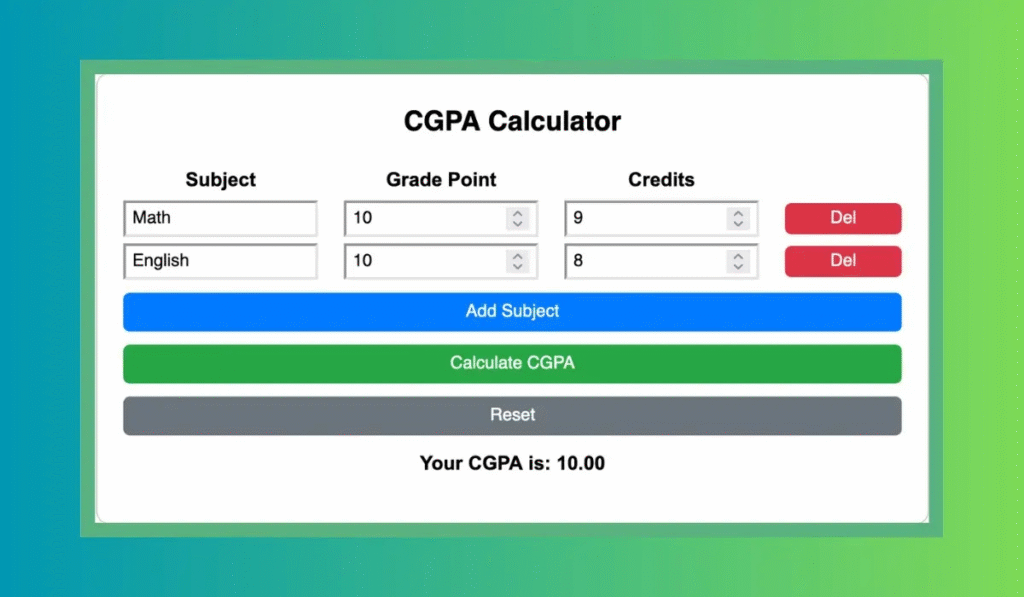
This article provides a detailed exploration of the concept of CGPA, its origins, objectives, relevance in modern education, and the broader social and regional impact of tools like the average CGPA calculator. Beyond the technical aspects, we will also examine state-wise initiatives, the role of such tools in rural development and women empowerment, success stories, global comparisons, challenges, and prospects for the future.
What is CGPA and Why Does it Matter?
Cumulative Grade Point Average (CGPA) is a standardized method of assessing student performance across subjects and semesters. Instead of raw percentages, CGPA uses a grade point system where each subject is assigned a grade corresponding to the student’s marks. These grade points are then averaged to present a comprehensive measure of performance.
The average CGPA calculator simplifies this process by automatically computing the weighted average of grade points across subjects, helping students avoid complex manual calculations. This is especially useful in countries like India where the Central Board of Secondary Education (CBSE) and various universities have integrated the CGPA system.
The importance of CGPA lies in its ability to:
- Provide a uniform metric for student performance.
- Reduce the pressure of minute percentage differences.
- Facilitate international recognition of academic records.
- Act as a benchmark for higher education admissions and employment opportunities.
A Brief History of CGPA in Academic Systems
The concept of a grade point average originated in the United States during the early 20th century, when universities sought a standardized method to evaluate students across diverse courses. Over time, this system spread globally and was adapted to local educational frameworks.
In India, the CBSE introduced CGPA in 2010 for class 10 students. The intent was to replace the rigid percentage-based evaluation with a more flexible, student-friendly system. Since then, universities and professional institutions across the country have adopted GPA and CGPA models to align with international standards.
With these changes, the demand for accurate computation tools increased, giving rise to the average CGPA calculator. Initially, calculations were done manually or through simple spreadsheets, but digital calculators have now become sophisticated, offering instant results and even conversion to percentage or international GPA formats.
Objectives of an Average CGPA Calculator
The development of an average CGPA calculator serves multiple purposes:
- Accuracy and Efficiency – Manual calculations are prone to error, particularly when weighted grades are involved. Calculators ensure precision.
- Time-Saving – Students can compute results instantly, freeing time for academic planning.
- Accessibility – Online calculators are widely accessible, ensuring that students in both urban and rural areas benefit equally.
- Transparency – Parents, educators, and students can cross-verify results, ensuring accountability.
- Guidance for Career Planning – By understanding their CGPA trends, students can identify strengths and weaknesses, crucial for higher education and employment planning.
How an Average CGPA Calculator Works
At its core, a CGPA calculator processes grade points assigned to each subject. The formula is simple:
CGPA = (Sum of Grade Points in all subjects) ÷ (Number of subjects)
However, in cases where credits vary across subjects, a weighted average formula is applied:
CGPA = (Sum of Grade Points × Credit Hours) ÷ (Total Credit Hours)
Modern calculators automate this process. Users input subject grades or points, and the calculator instantly provides the average CGPA, often with percentage conversion.
For example, if a student secures grade points 9, 8, 7, 9, and 10 across five subjects, the CGPA will be:
(9 + 8 + 7 + 9 + 10) ÷ 5 = 8.6.
Such simplification highlights why the average CGPA calculator has become so popular among students and educators.
Regional Impact of CGPA and Digital Calculators
The introduction of CGPA systems and supporting calculators has had significant regional impacts:
- Urban Regions: Students in metropolitan cities benefit from easy access to digital tools, coaching centers, and expert guidance on GPA and CGPA conversion.
- Rural Regions: In rural areas, the availability of free online calculators has leveled the playing field. Students with limited access to guidance can still compute accurate CGPAs, boosting confidence.
- State-wise Adoption: States like Kerala, Tamil Nadu, and Maharashtra have integrated CGPA into higher secondary frameworks, while others still rely partly on percentage systems. The availability of calculators ensures smooth transitions across boards.
These tools also contribute indirectly to social welfare initiatives by ensuring equal opportunities in educational evaluation, regardless of geography.
Role in Women Empowerment and Rural Development
Education is a cornerstone of women empowerment, and accurate academic evaluation plays a central role. Many state governments in India run women empowerment schemes that offer scholarships, fellowships, and reserved opportunities based on academic performance. For these initiatives, CGPA is often the eligibility criterion.
An average CGPA calculator enables female students, particularly from rural and underprivileged backgrounds, to assess their academic standing confidently. This ensures they can apply for schemes without depending on intermediaries.
Similarly, rural development initiatives increasingly focus on digital literacy. Introducing tools like CGPA calculators in rural schools not only benefits students academically but also improves their exposure to technology, building digital confidence.
Social Welfare and Policy Framework
Governments across the globe emphasize transparent, equitable evaluation in education. The CGPA system, backed by calculators, supports these policies in several ways:
- Scholarship Eligibility: Many welfare schemes for economically weaker sections, minorities, and marginalized communities require a minimum CGPA.
- Skill Development Programs: Technical institutions use CGPA-based cutoffs to admit students into vocational and skill-building programs.
- Employment Opportunities: State and central recruitment boards often set CGPA thresholds for applicants, reinforcing its policy relevance.
Thus, the average CGPA calculator aligns with the larger policy framework of fair, accessible education.
Success Stories and Case Studies
Several success stories highlight the transformative role of CGPA calculators:
- Case Study: Rural Bihar
A group of students in a government school in Bihar began using free online CGPA calculators introduced through a rural digital literacy program. Within two years, their awareness of academic performance improved dramatically, and the number of students applying for state scholarships doubled. - Case Study: Women in Engineering Colleges, Karnataka
Female engineering students in Karnataka used calculators not only to track academic progress but also to prepare for global exchange programs, where GPA equivalents were required. This simplified access to international opportunities.
These examples illustrate how a simple digital tool can create ripple effects in education and empowerment.
Challenges in Implementing CGPA Systems
While CGPA and its calculators have many advantages, challenges remain:
- Lack of Awareness: Many students, especially in remote areas, are unaware of how to use these tools effectively.
- Inconsistent Grading Systems: State boards and universities follow varied conversion formulas, leading to confusion.
- Over-Reliance on Grades: Excessive focus on CGPA may overshadow holistic development, including extracurricular skills.
- Digital Divide: Not all rural students have access to smartphones or reliable internet, limiting calculator use.
Addressing these challenges requires coordinated efforts by governments, educators, and NGOs.
Comparison with Other Grading Systems
Globally, grading systems vary significantly. Comparing CGPA with others helps contextualize its role:
- Percentage System: Still prevalent in many schools, this system is straightforward but lacks global comparability.
- GPA (Grade Point Average): Common in the US, GPA is similar to CGPA but often semester-specific rather than cumulative.
- Letter Grade System: Used in countries like the UK, this system emphasizes qualitative assessment but lacks the precision of CGPA.
The average CGPA calculator often incorporates conversion features, enabling students to translate scores into GPA or percentages, bridging international differences.
Future Prospects of CGPA Calculators
As education becomes increasingly digital, the role of calculators will expand further:
- AI-Integrated Calculators: Future tools may analyze performance trends and provide personalized improvement suggestions.
- Mobile Integration: Offline-capable apps will ensure rural students without constant internet access can still compute CGPAs.
- Blockchain for Transparency: Secure calculators may store results on blockchain networks, ensuring tamper-proof academic records.
- Policy-Linked Tools: Direct integration with scholarship and welfare portals could simplify application processes for students.
Thus, the future of average CGPA calculators is not just about computation but about enabling holistic academic ecosystems.
Frequently Asked Questions (FAQs)
Conclusion
The average CGPA calculator has emerged as more than just a tool for computation. It represents the intersection of education, technology, policy, and empowerment. From simplifying academic evaluations to supporting state-level welfare initiatives, rural development programs, and women empowerment schemes, CGPA calculators are driving inclusivity in education.
While challenges like the digital divide remain, the potential for future innovation is immense. As education systems continue to globalize, tools like the average CGPA calculator will not only ensure accuracy but also empower students to compete confidently on both national and international stages.
By linking technical precision with broader social benefits, the average CGPA calculator stands as a symbol of modern educational progress, blending technology with human aspiration.