How to Calculate Overall CGPA of All Semesters – Step-by-Step Guide
Calculating cumulative grade point average is a routine yet pivotal task for students, educators, and institutions. Understanding how to calculate overall CGPA of all semesters is essential not only for academic reporting and graduation eligibility but also for scholarship assessment, recruitment screening, and cross-border credential recognition. This comprehensive guide walks you through the math, the logic, the policies that shape reporting, real-world implementation at state and institutional levels, success stories, common pitfalls, practical tools, and future improvements. Read on to gain clear, actionable knowledge and to master the steps required to compute an accurate cumulative measure of academic performance.
Why the Question of How to Calculate Overall CGPA of All Semesters Matters
Universities, boards, employers, and scholarship committees depend on CGPA (Cumulative Grade Point Average) as a compact indicator of a student’s academic journey. Knowing how to calculate overall CGPA of all semesters enables:
- Fair assessment of long-term performance.
- Standardization across departments and institutions.
- Transparency for admissions and hiring processes.
- Policy-level data aggregation that informs regional educational planning.
- Visibility for state-wise benefits, scholarship allocations, and targeted programs such as women empowerment schemes or rural development scholarships that rely on merit lists.
Beyond immediate academic uses, the way CGPA is calculated affects social welfare initiatives and institutional incentives. Poorly designed or inconsistent CGPA calculations can skew opportunities and undermine equity.
What Is CGPA — Definitions and Core Concepts
CGPA is the weighted average of grade points obtained across multiple courses or semesters. Each course/semester contributes according to its credit value. Core components:
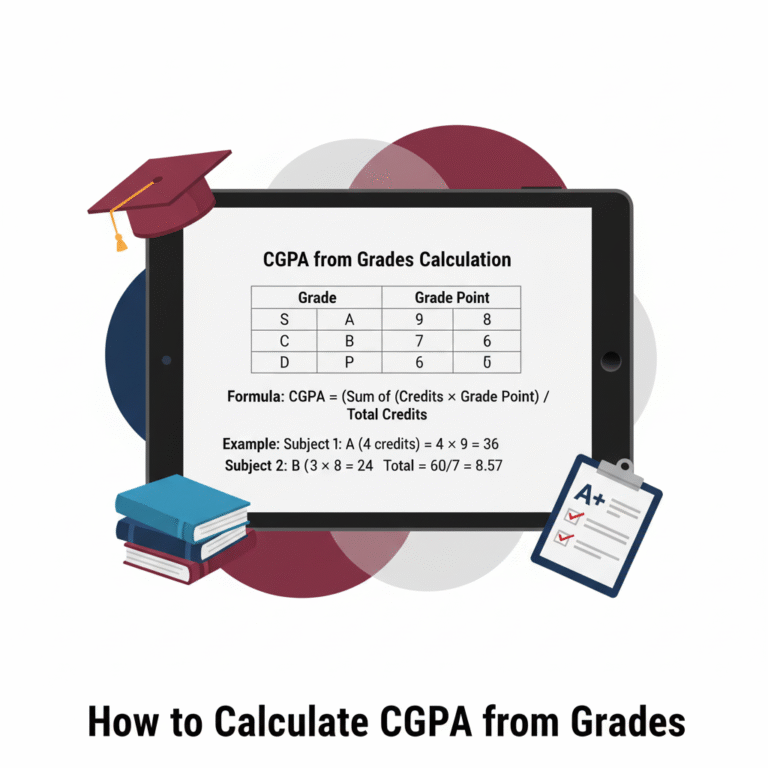
- Grade Point (GP): Numeric value assigned to a letter grade (e.g., A = 10, B = 8).
- Credit (C): Weight assigned to a course or semester that reflects contact hours or workload.
- Semester Grade Point Average (SGPA): Weighted average of grade points within a semester.
- Cumulative Grade Point Average (CGPA): Weighted average of GPAs (or grade points) across all semesters, adjusted by credits.
This guide focuses on how to calculate overall CGPA of all semesters using the credit-weighted method, the most accurate and widely used approach.
Common Grading Scales and Their Role in Calculation
Grading schemes vary by country and institution. Examples include:
- 10-point scale (common in India): A+ = 10, A = 9, B+ = 8, etc.
- 4-point scale (common in the U.S.): A = 4.0, B = 3.0, etc.
- Percentage-to-GPA conversions as used in some evaluation frameworks.
Always confirm the institutional grading scale before calculating. Conversions may be required when comparing or aggregating data across institutions or states.
Step-by-Step: How to Calculate Overall CGPA of All Semesters
The standard, robust method uses credit-weighted semester grade points. Follow these steps:
- Collect Data
For every semester, gather: total credits completed that semester and the semester’s SGPA (or the grade points for every course). - Multiply SGPA by Semester Credits
For each semester, calculate: Semester Grade Points = SGPA × Semester Credits. - Sum Semester Grade Points
Add all semester grade points across all semesters to get Total Grade Points. - Sum All Credits
Add all semester credits across all semesters to get Total Credits. - Divide
Compute CGPA: Overall CGPA = Total Grade Points ÷ Total Credits. - Round Appropriately
Round to the precision required by your institution (often two decimal places).
Formula (compact)
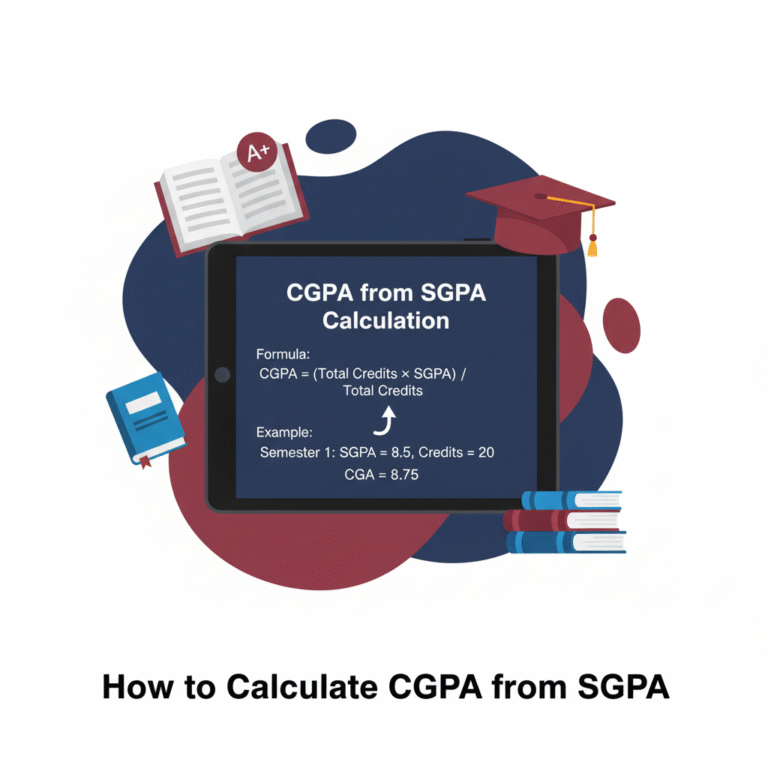
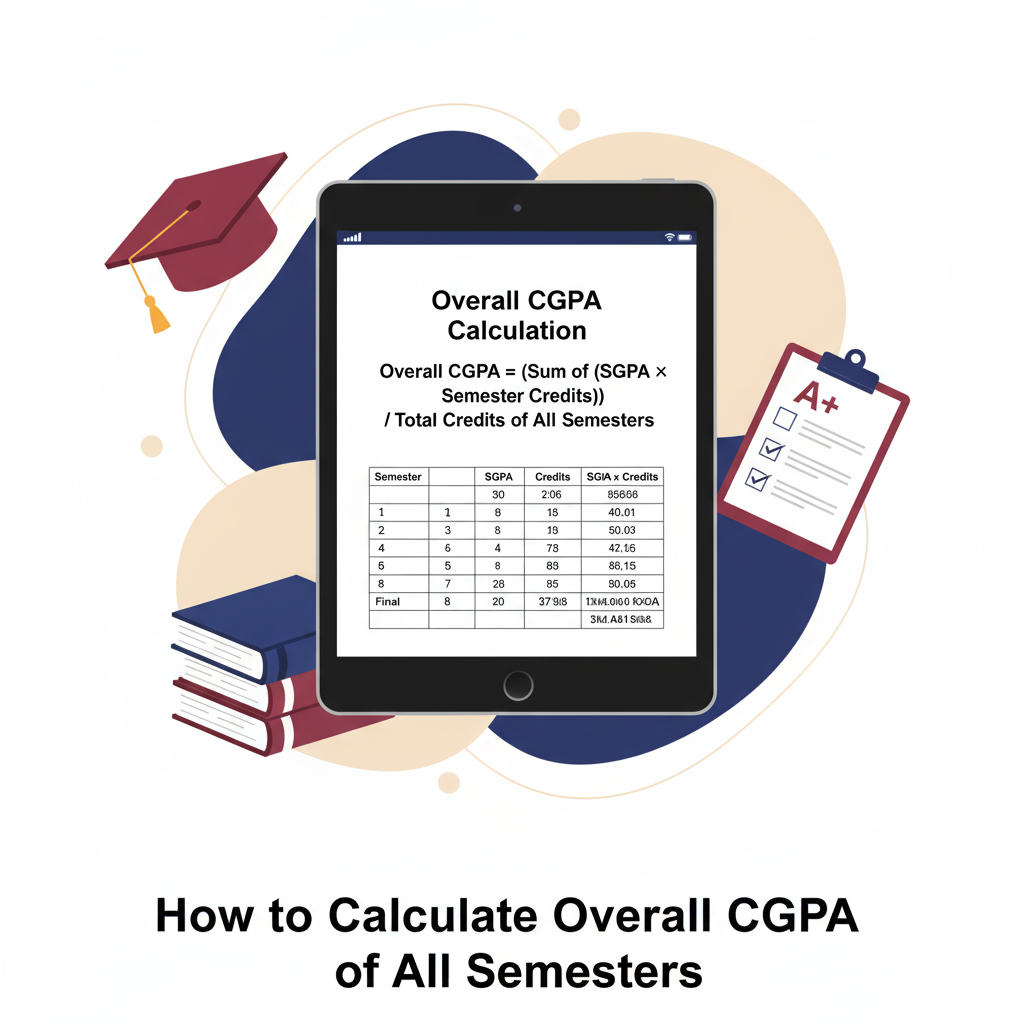
Overall CGPA = (Σ (SGPA_i × Credits_i)) / (Σ Credits_i), where i runs over all semesters.
This method answers how to calculate overall CGPA of all semesters accurately because it factors in the relative weight of each semester.
Worked Example — Demonstrating How to Calculate Overall CGPA of All Semesters
Let’s illustrate with a concrete example. Suppose a student has eight semesters with the following SGPAs and credits:
- Semester 1: SGPA = 8.2, Credits = 18
- Semester 2: SGPA = 7.8, Credits = 20
- Semester 3: SGPA = 8.5, Credits = 22
- Semester 4: SGPA = 9.0, Credits = 20
- Semester 5: SGPA = 8.7, Credits = 18
- Semester 6: SGPA = 8.0, Credits = 22
- Semester 7: SGPA = 8.3, Credits = 20
- Semester 8: SGPA = 8.6, Credits = 20
Step-by-step calculation:
- Multiply each SGPA by its credits:
- S1: 8.2 × 18 = 147.6
- S2: 7.8 × 20 = 156.0
- S3: 8.5 × 22 = 187.0
- S4: 9.0 × 20 = 180.0
- S5: 8.7 × 18 = 156.6
- S6: 8.0 × 22 = 176.0
- S7: 8.3 × 20 = 166.0
- S8: 8.6 × 20 = 172.0
- Sum grade points: 147.6 + 156.0 + 187.0 + 180.0 + 156.6 + 176.0 + 166.0 + 172.0 = 1341.2.
- Sum credits: 18 + 20 + 22 + 20 + 18 + 22 + 20 + 20 = 160.
- Overall CGPA = 1341.2 ÷ 160 = 8.3825, often rounded to 8.38.
This example shows precisely how to calculate overall CGPA of all semesters, accounting for semester-to-semester credit variation.
Variations and Edge Cases
When Credits Are Equal Across Semesters
If each semester carries equal credits, overall CGPA is simply the arithmetic mean of the SGPAs. But always verify because course credit differences can distort an average.
When Course-Level Data Is Needed
If an institution reports only course grades, compute grade points for each course, multiply by course credits, sum across all courses, and divide by total credits. This is equivalent to the semester-weighted approach if done comprehensively.
Repeats and Failed Courses
Policies differ: some institutions replace failed-course grade points when a course is retaken; others average both attempts. Confirm the policy before calculating.
Transfer Credits and Integrated Programs
Transfer credits may carry different weight or be marked as pass/fail. Clarify how these are factored into CGPA—some institutions exclude pass/fail transfer credits from CGPA calculations.
Practical Tools: Excel and Automated Calculators
Excel formula for a credit-weighted CGPA:
- Column A: Semester Credits (C1..Cn)
- Column B: Semester SGPA (G1..Gn)
- Column C: =A2*B2 (Semester Grade Points)
- Total Grade Points: =SUM(C2:Cn)
- Total Credits: =SUM(A2:An)
- CGPA: =SUM(C2:Cn) / SUM(A2:An)
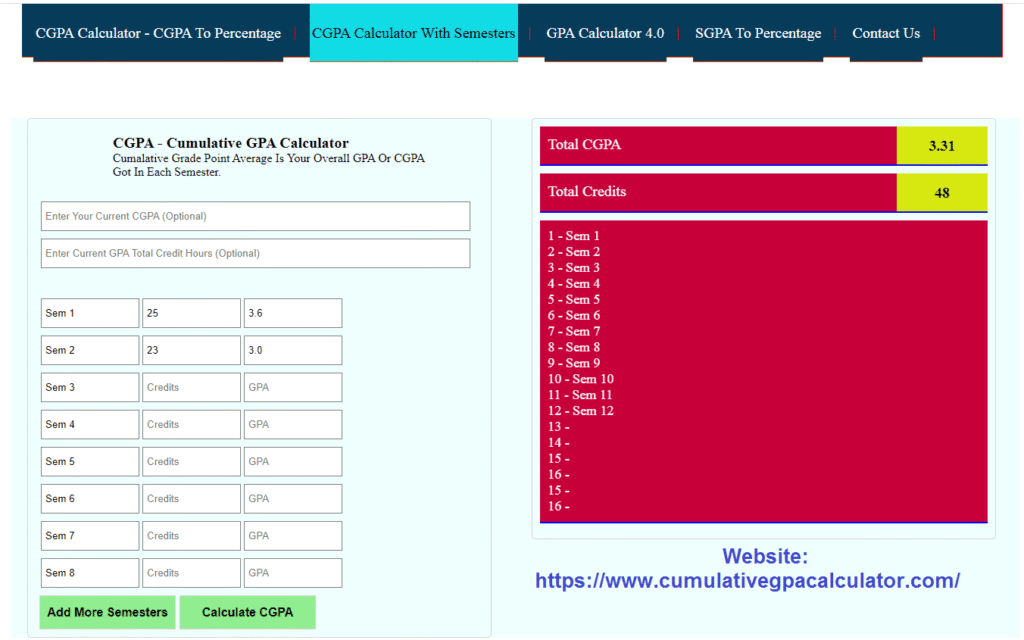
Example formula in a cell: =SUMPRODUCT(A2:A9,B2:B9)/SUM(A2:A9)
Many universities provide online calculators that account for special rules (repeat exams, grade replacement). When in doubt, replicate the institution’s official calculation method.
Rounding, Precision, and Presentation
Be mindful of institutional rules for rounding. Some institutions truncate after a specific decimal, while others round to two decimal places. When you’re documenting how to calculate overall CGPA of all semesters, always state the rounding convention used.
CGPA vs Percentage vs Cumulative Percentage — Conversion Caveats
CGPA does not always map linearly to percentage. Different boards and institutions use conversion formulas. For example, some use Percentage ≈ CGPA × 10, while others apply different coefficients. When making comparisons or reporting to employers, be explicit about conversions and their limitations.
Equity, Policy Frameworks, and State-Level Impacts
Understanding how to calculate overall CGPA of all semesters is more than technical; it intersects with policy frameworks at institutional and state levels. Considerations include:
- Scholarship Allocation: CGPA thresholds often determine eligibility for state scholarships and state-wise benefits. Transparent calculation methods ensure equitable access.
- Recruitment and Employment: Government hiring schemes and public-sector recruitment may employ CGPA cutoffs. Uniform calculation supports fairness across candidates from diverse institutions.
- Women Empowerment Schemes: Merit-based components of some schemes target high-CGPA students from underrepresented groups. Clear measurement practices ensure deserving candidates are not disadvantaged due to inconsistent CGPA rules.
- Rural Development and Social Welfare: State programs distributing educational support to rural students rely on CGPA-based eligibility. Accurate calculation helps in targeting resources to high-performing students in underserved regions.
Policymakers and institutions should harmonize CGPA reporting to prevent fragmentation that undermines these critical initiatives.
Implementation: Institutional Best Practices
Institutions should adopt transparent policies and publicly document:
- Grading scales and conversions.
- Treatment of repeats and withdrawals.
- Precision and rounding rules.
- Handling of transfers and pass/fail credits.
Automating CGPA calculations in student information systems reduces errors and helps administrators respond to queries about how to calculate overall CGPA of all semesters quickly and consistently.
Success Stories: When Clear CGPA Calculations Drove Impact
Several universities have reported measurable gains after standardizing CGPA reporting:
- Improved scholarship distribution, with previously marginal students receiving support due to consistent credit weighting.
- Streamlined recruitment pipelines where employers reported better cross-campus comparability.
- Enhanced policy targeting at state level: accurate CGPA data enabled more precise allocation of women empowerment scholarships and rural development stipends.
These success stories underscore that precise calculation and transparency are crucial for trust and impact.
Common Challenges and How to Overcome Them
Challenge: Inconsistent Policies across Colleges
Solution: Develop state-level guidelines or university-wide policies that clarify definitions and standardize procedures.
Challenge: Conversion between Different Scales
Solution: Publish official conversion tables; use percentile or normalized scores where direct conversion is infeasible.
Challenge: Handling Repeats and Academic Offenses
Solution: Adopt clear repeater policies and ensure they are applied consistently and published.
Challenge: Data Integrity and Manual Errors
Solution: Use integrated SIS (Student Information Systems) with audit trails and automated checks.
All of these influence the question of how to calculate overall CGPA of all semesters by affecting the inputs and the rules applied to those inputs.
Comparative Analysis: CGPA vs Other Academic Metrics
CGPA is compact and convenient but not exhaustive. Compare with:
- Percentage/Marks: More granular at the course level, but hard to standardize across systems.
- Rank/Percentile: Useful within cohorts but not comparable across institutions.
- Honors Distinctions: Often based on CGPA thresholds; dependent on consistent calculation.
- Competency-Based Metrics: Emerging approaches evaluate mastery rather than averaged scores.
In many contexts—scholarships, admissions, employment—CGPA remains the dominant metric, so mastering how to calculate overall CGPA of all semesters is essential.
Transparency and Student Empowerment
Students should be provided with tools and documentation that let them independently verify their CGPA. When students understand how to calculate overall CGPA of all semesters, they can better plan course loads, retakes, and graduation timelines.
Future Prospects: Improving CGPA Systems
Potential improvements that address fairness and utility:
- Normalized CGPA: Adjust for program difficulty or cohort inflation.
- Competency-Anchored Scores: Blend CGPA with competency assessments to give a fuller picture.
- Open APIs for Transcript Data: Facilitate secure sharing of CGPA data for scholarships and employment.
- AI-Driven Audit Tools: Identify anomalies, credit overlaps, and errors in CGPA computation.
Policymakers should consider these enhancements as part of broader education reform and digital transformation strategies.
Checklist: How to Calculate Overall CGPA of All Semesters — Quick Reference
- Verify the grading scale used.
- Confirm credits per semester or per course.
- Decide on rounding/truncation policy.
- Decide treatment of repeats, withdrawals, and transfer credits.
- Use the formula: Overall CGPA = Σ(SGPA_i × Credits_i) / Σ(Credits_i).
- Cross-check with institutional guidelines or official transcripts.
Communicating CGPA in Applications and Official Records
When you present your CGPA, clarify the scale and rounding method. Example: “CGPA: 8.38/10 (calculated as credit-weighted average of all eight semesters; rounded to two decimals).” This transparency reduces misinterpretation when institutions, employers, or state agencies evaluate credentials.
Sample Template for Institutional Policy Statement
An institutional policy statement answering “how to calculate overall CGPA of all semesters” might read:
“The overall CGPA is calculated as the credit-weighted mean of all recorded semester grade point averages. For each semester, the SGPA is multiplied by the semester’s credit load; the sum of these values is divided by the total credits earned. Repeated courses are included/excluded as per section X of the academic regulations. CGPA is reported on a 10-point scale and rounded to two decimal places.”
Practical Tips for Students
- Keep a running spreadsheet of semester credits and SGPAs to verify CGPA.
- Understand your program’s credit distribution—more credits mean greater impact on CGPA.
- If your institution allows grade replacement, calculate both before and after replacement to understand impact.
- If converting from a different grading scale, always request or consult the institution’s official conversion.
How Calculations Affect Broader Social and Educational Goals
When governments or universities distribute state-wise benefits, scholarships, or social welfare support, CGPA-based eligibility plays a significant role. This ties the technical question of how to calculate overall CGPA of all semesters into the broader matrix of social programs, such as:
- Women empowerment schemes offering tuition support to top-performing female students.
- Rural development scholarships prioritizing high-achieving students from underserved districts.
- State-driven merit scholarships that allocate benefits based on standard CGPA thresholds.
Transparent and standardized CGPA calculations help minimize bias and ensure that policy objectives are met fairly.
Comparing International Practices
Different countries and universities use distinct practices for cumulative averages. When dealing with international admissions or recognition, understanding how to calculate overall CGPA of all semesters in the home system and converting it according to recognized frameworks is important. Use official conversion guides or credential evaluation services for cross-border comparability.
Audit and Quality Assurance
Institutions should audit CGPA calculations periodically. Random checks, student audits, and automated reconciliation with course records help maintain trust and accuracy. Audits are especially important when CGPA is tied to financial disbursements or policy-driven benefits.
Closing Thoughts
Knowing how to calculate overall CGPA of all semesters is more than a computation; it’s about fairness, clarity, and impact. Whether you are a student tracking progress, an administrator ensuring accurate records, or a policymaker allocating state-level benefits, mastering the credit-weighted calculation is essential. Adopt transparent policies, employ reliable tools, and communicate clearly to ensure CGPA serves its role as a fair, comparable, and useful academic indicator.