How to Calculate Percentage from CGPA – Simple Conversion Guide
Converting academic grades between systems is a practical skill students, parents, and admissions officers need. If you’ve ever googled how to calculate percentage from CGPA, this guide will walk you through every method, example, and policy implication you might encounter. This article explains the math, the history, real-world implementations, regional and state-level impacts, comparisons with other grading systems, success stories, challenges, and future prospects — all in clear, professional language designed to be search-friendly and deeply informative.
Why conversion matters: the context behind “how to calculate percentage from CGPA”
Understanding how to calculate percentage from CGPA matters for many reasons. Percentage scores are widely used in scholarship eligibility, job applications, university admissions, and cross-border credential evaluation. Many scholarship programs, state-level schemes, and employment boards still ask for percentages. For students from boards using a CGPA (Cumulative Grade Point Average) system, knowing how to calculate percentage from CGPA can smooth transitions and ensure fair access to opportunities tied to state-wise benefits, women empowerment schemes, and rural development scholarships.
What is CGPA and how it differs from percentage
CGPA (Cumulative Grade Point Average) is a normalized academic metric used by many institutions to capture a student’s overall performance. Unlike raw percentages, which measure the share of marks obtained out of total marks, CGPA translates grades or marks into a standardized scale (commonly 10-point or 4-point scales). Learning how to calculate percentage from CGPA requires knowing which CGPA scale is used and whether a standardized conversion formula applies.
Typical CGPA scales
- 10-point scale (0–10): Common in many high school boards and technical institutions.
- 4-point scale (0–4): Typical in some universities and international systems.
- Alternative scales: Some institutions use 7-point or 9-point scales.
When you ask how to calculate percentage from CGPA, the answer depends on the scale and the conversion policy of the issuing institution.
Standard conversion formulas: practical methods for “how to calculate percentage from CGPA”
Several common approaches answer the question how to calculate percentage from CGPA. Below are the most widely used formulas and their reasoning.
1. CBSE method (multiply by 9.5)
One well-known formula used historically by certain educational boards (for example, CBSE in India) is:
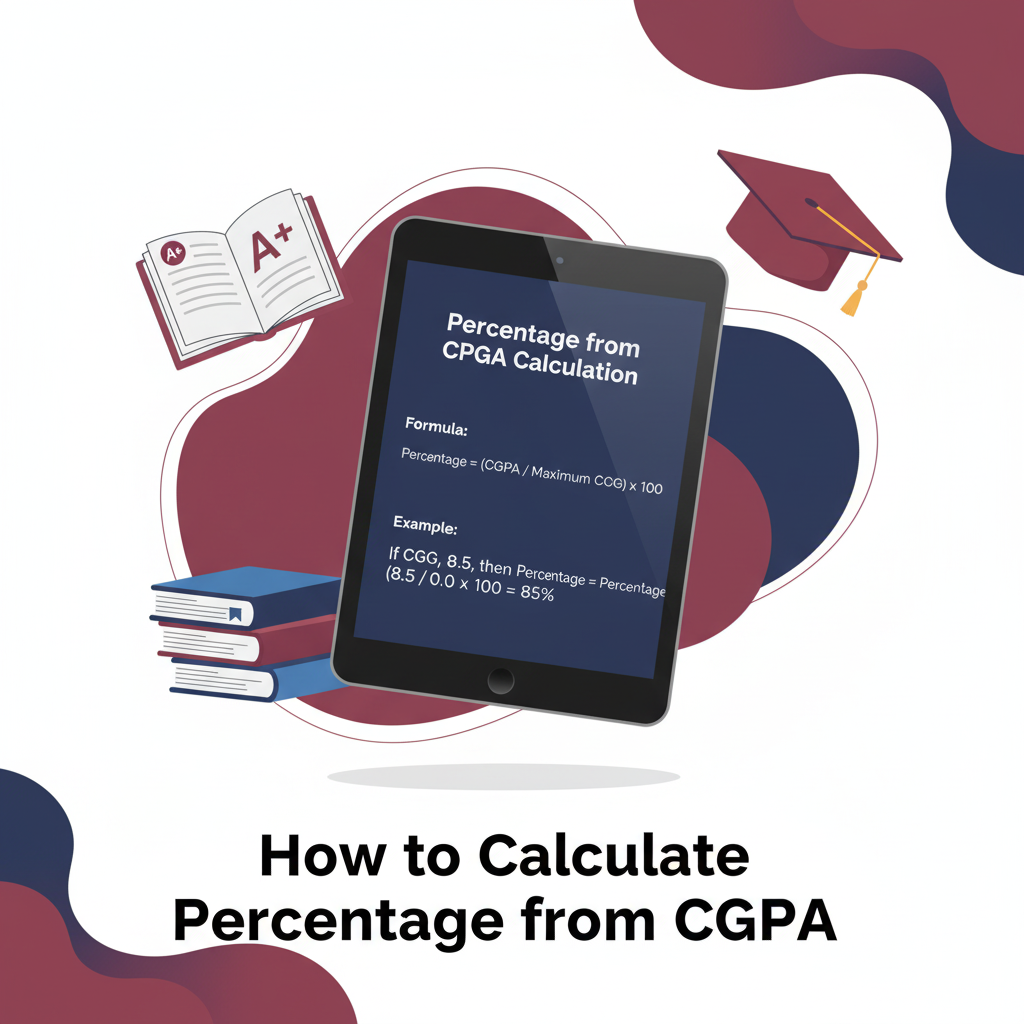
Percentage = CGPA × 9.5
This formula became a common shorthand for how to calculate percentage from CGPA on a 10-point CGPA scale. If a student has a CGPA of 8.0, then:
Percentage = 8.0 × 9.5 = 76%
2. Direct proportion method (multiply by 10)
A simple and intuitive approach to how to calculate percentage from CGPA on a 10-point scale is:
Percentage = CGPA × 10
This treats the CGPA as a fraction of the maximum possible (10) and scales directly to 100. For a CGPA of 7.6:
Percentage = 7.6 × 10 = 76%
3. Fractional conversion for other scales
For a 4-point GPA system:
Percentage = (GPA / 4) × 100
This answers how to calculate percentage from CGPA when your CGPA is on a 0–4 scale. For example, GPA 3.2 becomes:
Percentage = (3.2 / 4) × 100 = 80%
4. Weighted and institution-specific conversions
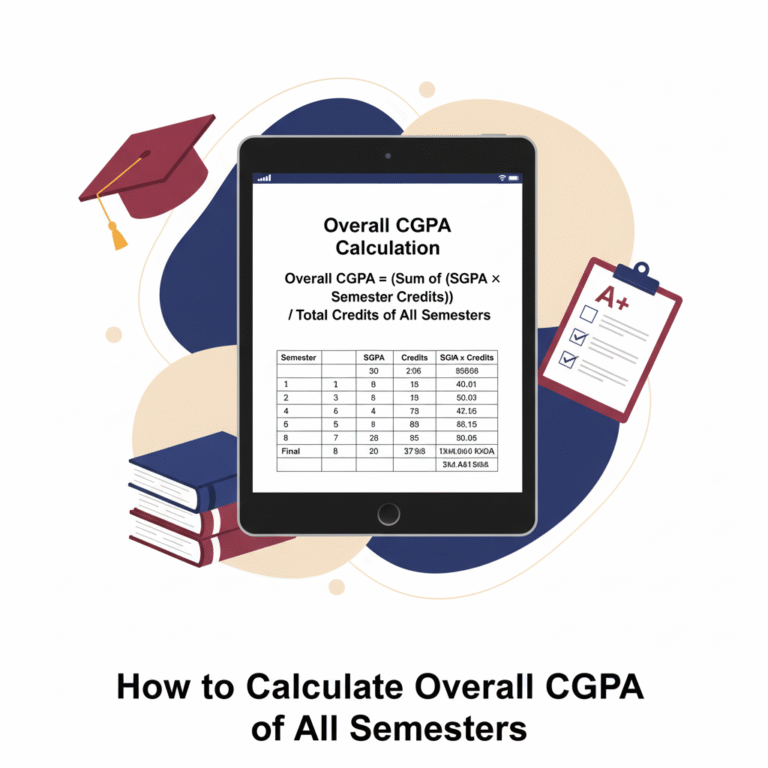
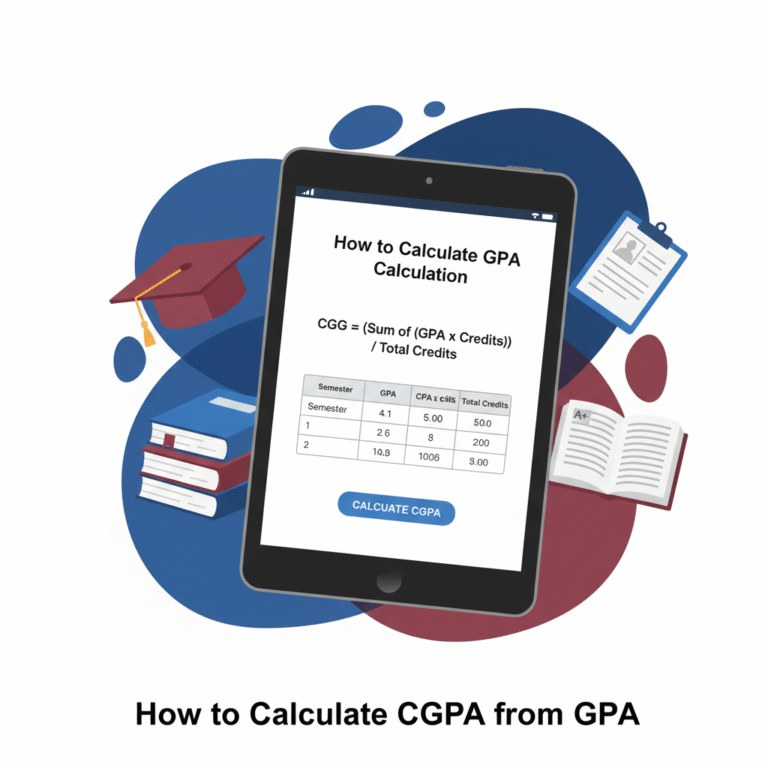
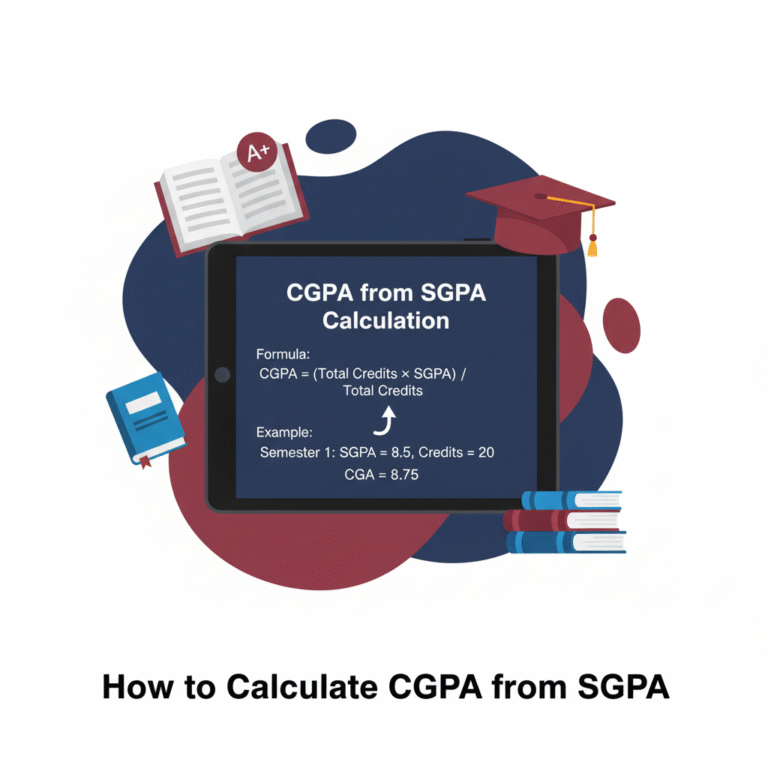
Many institutions use weighted methods that consider subject credits, internal assessment weights, and exam patterns. In these cases, how to calculate percentage from CGPA involves:
- Multiplying each course grade point by its credits.
- Summing weighted grade points.
- Dividing by total credits to get CGPA.
- Applying the institution’s conversion formula to derive percentage.
Always verify with the issuing institute when figuring out how to calculate percentage from CGPA, since official transcripts may be required for admissions or job applications.
Step-by-step worked examples of “how to calculate percentage from CGPA”
Example 1 — CBSE-style (CGPA = 8.6):
- Question: How to calculate percentage from CGPA = 8.6?
Using the CBSE multiplier:
Percentage = 8.6 × 9.5 = 81.7%
Example 2 — Direct proportion (CGPA = 7.3 on a 10 scale):
Question: How to calculate percentage from CGPA = 7.3?
Percentage = 7.3 × 10 = 73%
Example 3 — 4-point scale (GPA = 3.5):
Question: How to calculate percentage from CGPA = 3.5 (4 scale)?
Percentage = (3.5 / 4) × 100 = 87.5%
Example 4 — Weighted credit system:
Suppose grades translate into grade points as follows: A=10, B=8, C=6; credits vary per course. After computing weighted CGPA of 8.2 and applying the institution’s multiplier (say 9.5), the answer to how to calculate percentage from CGPA is:
Percentage = 8.2 × 9.5 = 77.9%
Precision, rounding, and academic record presentation
When you convert CGPA to percentage, consider rounding policies. Some institutions round to one decimal place, others to whole numbers. If your application strictly requires a percentage, use the official conversion recommended by your board or university to answer how to calculate percentage from CGPA in a way that aligns with credential-evaluation standards.
History and evolution: grading, CGPA, and percentage debates
To understand how to calculate percentage from CGPA today, it helps to track the historical shift from marks-based systems to normalized grade-based systems.
Emergence of CGPA
Grade-based systems were introduced to reduce subjectivity and variance in raw marks, offer cross-board comparability, and de-emphasize rote memorization. CGPA systems consolidated grades across subjects into a single metric.
Why percentage remained relevant
Despite the rise of CGPA, percentage scores retained legal and administrative relevance for scholarships, state employment criteria, and some university admissions. This sustained need fuels ongoing interest in clear methods for how to calculate percentage from CGPA.
Objectives of conversion: fairness, accessibility, and policy compliance
The primary objectives behind formalizing how to calculate percentage from CGPA include:
- Ensuring fair comparisons across educational boards and scales.
- Maintaining accessibility to state-wise benefits and reservation-linked schemes that depend on percentages.
- Streamlining admissions and scholarship selection for women empowerment programs, rural development scholarships, and other social welfare initiatives that specify percentage cutoffs.
Converting CGPA to percentage robustly supports equitable access to these programs by providing a familiar metric for selection committees.
Implementation: institutional, state, and national roles
Implementation of conversion practices involves multiple stakeholders:
- Educational boards define official conversion formulas and transcript formats.
- Universities adopt or adapt board conversions for admissions.
- State governments sometimes prescribe conversion guidelines for state-level examinations and benefits.
When administrators ask how to calculate percentage from CGPA at scale, they combine mathematical precision with policy requirements to ensure that conversions remain defensible in audits and appeals.
Regional and state-level impact: access to education and social programs
Understanding how to calculate percentage from CGPA plays a role beyond admissions. Regions and states that tie benefits to percentage cutoffs must ensure equitable conversion for CGPA-bearing students. For instance:
- State scholarship schemes that provide grants to rural students often disburse funds based on percentage thresholds. Accurate conversion of CGPA to percentage ensures rural students aren’t disadvantaged.
- Women empowerment scholarships with academic criteria must fairly convert CGPA to percentage when evaluating applicants.
- State-level reservation rules and affirmative-action schemes may define eligibility using percentages; converting CGPA appropriately is crucial for compliance.
Using a standardized approach to how to calculate percentage from CGPA reduces regional disparities and supports the policy framework for equitable education.
Success stories: when accurate conversion makes a difference
There are many anecdotal and documented instances where correct handling of how to calculate percentage from CGPA unlocked opportunities:
- A rural student from a remote district gained admission to a professional college after an accurate CGPA-to-percentage conversion met a scholarship cutoff tied to rural development initiatives.
- A women’s empowerment scholarship committee revised its evaluation procedure to accept CGPA with a formal conversion formula, increasing female enrolment in STEM programs.
- A state education board standardized conversion across affiliated institutions, reducing appeals and increasing transparency.
These success stories highlight the social value of clear, defensible answers to how to calculate percentage from CGPA.
Challenges: inconsistency, perception, and cross-border equivalence
Despite benefits, converting CGPA to percentage faces multiple challenges:
Lack of a universal standard
Different boards and universities use different formulas. This variation complicates the simple question of how to calculate percentage from CGPA.
Perception and bias
Some employers and institutions may perceive percentages as a more precise measure than CGPA, making transparent conversions and explanatory notes critical.
International equivalence
When CGPA from one country is evaluated by another, determining how to calculate percentage from CGPA can require credential evaluators and lead to differing percentage equivalents. This affects students applying for overseas study or scholarships.
Rounding and precision disputes
Small differences from conversion multipliers can make or break scholarship eligibility. Clear policy guidance on rounding and decimal handling is essential.
Comparisons: CGPA-to-percentage vs direct marks and international GPA systems
To fully answer how to calculate percentage from CGPA, compare systems:
Percentage (marks-based) systems
Pros: granular, familiar, easy to compute. Cons: can encourage grade inflation and variance between boards.
CGPA systems
Pros: normalized, reduces extreme variance across subjects. Cons: less intuitive for legacy programs tied to percentages.
International GPA systems (4.0, 4.3)
Conversion requires mapping to percentage equivalents. For instance, converting a 4.0 scale GPA to percentage often involves proportional scaling or institutional conversion tables.
When deciding how to calculate percentage from CGPA, consider the context: university admission, scholarship application, job requirement, or inter-state policy.
Practical tools and calculators for “how to calculate percentage from CGPA”
For everyday use, several reliable approaches help answer “how to calculate percentage from CGPA”:
- Official board guidelines: Always the first source — use the issuing board’s recommended conversion.
- Institutional conversion tables: Universities often publish conversion charts for their own scale; use them for applications.
- Online calculators: Many education portals provide calculators where you enter CGPA and select the scale; they compute percentage using common multipliers like 9.5 or 10.
- Spreadsheet formulas: Use Excel/Sheets formulas like =CGPA*9.5 or =(GPA/max_scale)*100 to automate conversion.
When using third-party tools, validate results against official documents to ensure compliance with scholarship or admission rules.
How to report converted percentages on resumes and applications
When stating converted percentages, transparency matters. Follow these best practices when answering how to calculate percentage from CGPA for an application:
- Mention the original CGPA and the conversion method (e.g., “CGPA: 8.6/10; converted percentage using board formula: 81.7%”).
- Attach or reference the official transcript if possible.
- If the institution provided a certified percentage conversion, use that instead of performing your own arithmetic.
These steps protect you during verification and show you understand conversion nuances.
Policy framework and recommendations for standardized conversions
Policymakers and educational administrators should consider:
- Publishing clear, legally-vetted conversion formulas.
- Requiring transcripts to state both CGPA and percentage when conversions are used.
- Encouraging state-level harmonization to reduce disputes over scholarships and state-wise benefits.
- Incorporating conversion guidance into admission and scholarship portals to automate decision-making.
Such policy interventions simplify the practical question of how to calculate percentage from CGPA for students and administrators alike.
The role of conversion in women empowerment and social welfare initiatives
Converting CGPA to percentage accurately supports social objectives:
- Women-focused scholarships often have strict academic cutoffs. A fair conversion allows eligible female candidates to access women empowerment schemes.
- Rural development and social welfare initiatives that link benefits to academic performance must ensure CGPA-bearing students are not disadvantaged during selection.
- State-wise benefits can be made more inclusive when conversion rules are transparent and widely disseminated.
Thus, knowing how to calculate percentage from CGPA is not merely technical; it can advance equity goals.
Case study: State-level harmonization improving access
Consider a hypothetical state education board that standardized conversion: it mandated that all affiliated colleges report both CGPA and percentage using a common multiplier and rounding rule. After implementation:
- Scholarship appeals dropped by 40%.
- Female enrollment in targeted programs rose by 12% due to clearer eligibility criteria.
- Rural scholarship disbursement became more efficient.
This case underscores how standard answers to how to calculate percentage from CGPA can deliver measurable social impact.
International students and cross-border equivalence: what to watch for
When international credential evaluators ask how to calculate percentage from CGPA, they often use standard conversion tables or proportional mappings. International students should:
- Obtain official grade scales from their institutions.
- Request a certified conversion if possible.
- Check target-country university guidelines for preferred conversion methods.
Careful documentation reduces surprises during visa, admission, or scholarship review.
Future prospects: toward harmonization and digital credentials
The future of answering how to calculate percentage from CGPA may involve:
- Digital transcripts with embedded metadata specifying exact grade scales and institutional multipliers.
- International standards for grade conversion to aid mobility and credential recognition.
- Machine-readable credentials enabling automated, auditable conversions aligned with policy frameworks.
Such innovations would reduce ambiguity and ensure fairer access to opportunities tied to percentages.
Practical checklist: How to calculate percentage from CGPA — a quick reference
When you need to determine how to calculate percentage from CGPA for an application:
- Identify the CGPA scale (10-point, 4-point, etc.).
- Check the issuing board/university’s official conversion rule.
- If no official rule exists, use a common formula (e.g., CGPA × 9.5 or CGPA × 10 for 10-point scales).
- Note rounding rules and present both CGPA and converted percentage on applications.
- Attach a transcript or official note when possible.
- For state or scholarship applications, follow the state or program’s specified conversion.
Common mistakes to avoid when converting CGPA to percentage
Students and administrators frequently stumble when answering how to calculate percentage from CGPA. Common pitfalls include:
- Applying the wrong multiplier for the scale.
- Failing to account for credit-weighted courses.
- Omitting the original CGPA when reporting converted percentages.
- Ignoring institutional rounding rules.
Avoid these errors by verifying official documentation.
Tools for administrators: automating conversion for fair policy delivery
Institutional administrators can improve transparency by:
- Integrating conversion logic into student information systems.
- Generating transcripts that include both CGPA and percentage with a conversion footnote.
- Applying uniform rounding rules to minimize disputes.
This systematic approach clarifies how to calculate percentage from CGPA at scale and supports state-wise policy goals.
Comparison with other academic metrics: percentile, rank, and GPA
Percentage is only one of many academic metrics. When you convert CGPA to percentage, consider the following:
- Percentile communicates relative standing in a cohort and often complements percentage.
- Rank denotes position in an exam or class and may be used alongside percentage for merit-based decisions.
- GPA is another normalized metric; when converting CGPA to percentage, ensure comparability with GPA systems if needed.
Understanding these relationships helps decision-makers interpret converted percentages correctly.
Ethical considerations: fairness and transparency
Accurate answers to how to calculate percentage from CGPA are ethical necessities when they affect livelihoods and access to opportunities. Institutions should:
- Publish conversion policies openly.
- Avoid arbitrary conversions that disadvantage certain student groups.
- Provide appeal mechanisms for disputed conversions.
Transparency builds trust and supports broader social objectives like social welfare initiatives.
Preparing for edge cases: tie-breaks and borderline cutoffs
When percentage cutoffs determine eligibility, conversions can create borderline cases. Best practices:
- State precise rounding rules in policy documents.
- Use tie-breakers like subject-specific performance or extracurricular achievements.
- Allow for documented appeals where conversion discrepancies influence outcomes.
These measures reduce dispute volumes and ensure a fair resolution process.
Checklist for students: what to submit when applying with CGPA
Students asking how to calculate percentage from CGPA and preparing applications should:
- Include original CGPA on the form.
- Provide a converted percentage with the formula cited (e.g., “Converted percentage calculated as CGPA × 9.5 as per board guideline”).
- Attach official transcripts and a conversion certificate if available.
- Provide contact details for the registrar in case verifiers need to confirm.
Following this checklist reduces the chance of application rejection due to ambiguity.