How to Calculate CGPA in KTU – Step-by-Step Student Guide
Understanding how to calculate CGPA in KTU is essential for every student enrolled in APJ Abdul Kalam Technological University (commonly called KTU). Whether you are a fresh undergraduate trying to translate your semester results into a cumulative measure, a postgraduate checking eligibility, or a recruiter interpreting a transcript, this guide explains the method step-by-step, the history and rationale behind the system, how KTU converts CGPA to percentage, common pitfalls, comparisons with other universities, and the broader academic and social impact of KTU’s grading approach.
This article shows how to calculate CGPA in KTU with examples, clarifies the difference between SGPA and CGPA, explains the credit-weighting logic, and highlights official guidance and typical practice around converting CGPA to percentage. Citations to KTU documents and widely used calculators are provided for the most important procedural points.
What CGPA and SGPA mean — a clear starting point
Before we explain how to calculate CGPA in KTU, it helps to fix definitions.
Cumulative Grade Point Average (CGPA) is the credit-weighted average of grade points obtained across all semesters of a program. Semester Grade Point Average (SGPA) is the same idea limited to the courses registered in a single semester.
Put simply:
- SGPA = (Sum of (grade point × credit) for the semester) ÷ (Sum of credits in that semester).
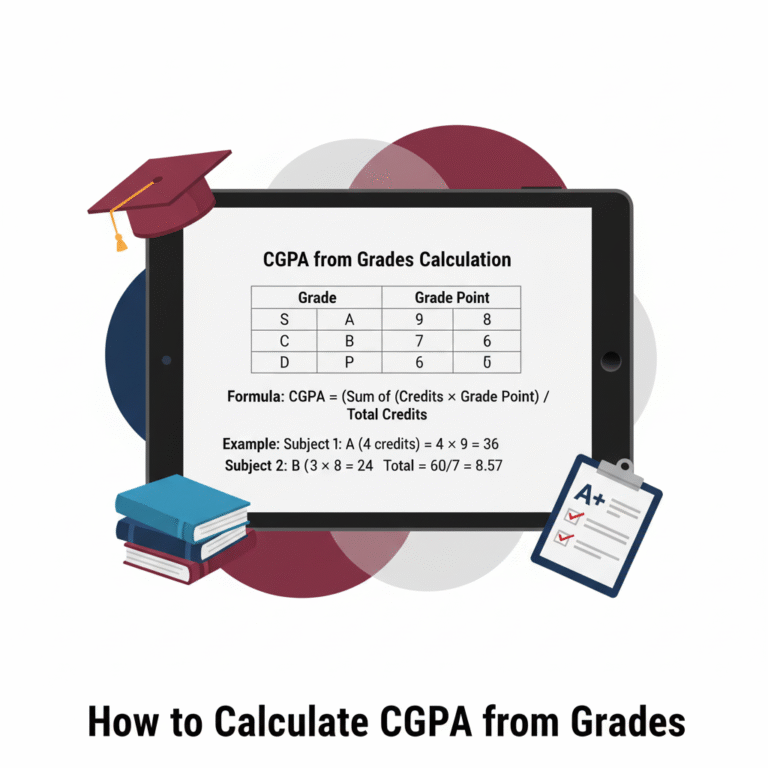
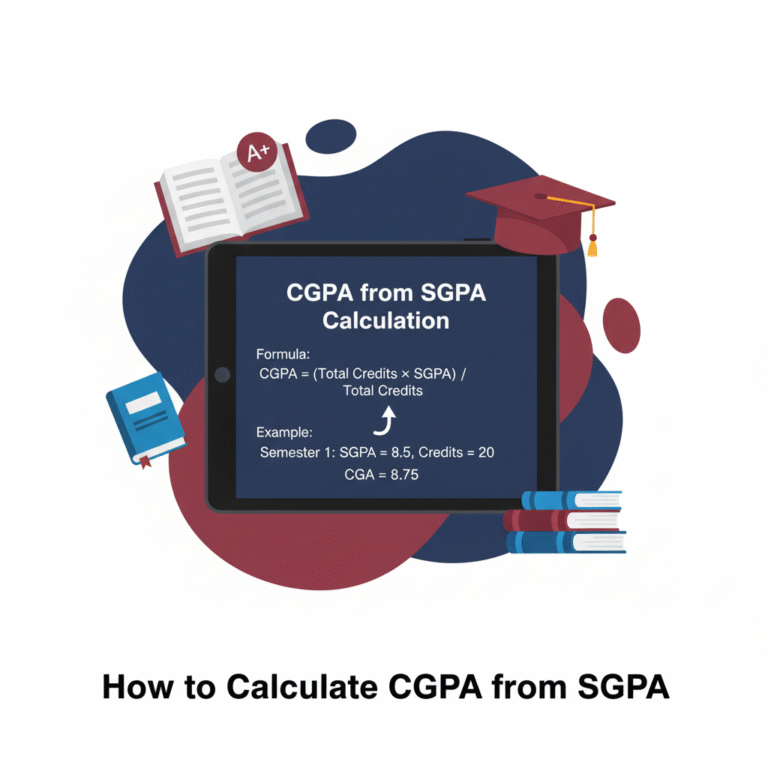
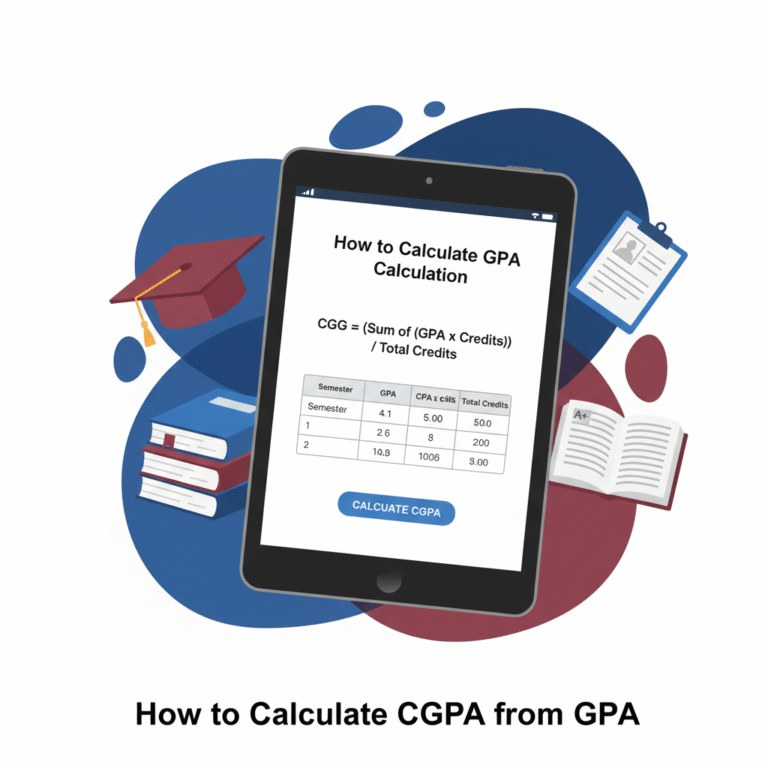
- CGPA = (Sum of (grade point × credit) for all semesters so far) ÷ (Sum of credits for all those semesters).
This weighted-average model is the method used by KTU and reflects the fact that some courses carry more credits (and therefore more importance) than others. KTU follows a 10-point grade scale for assigning grade points to letter grades. jawaharlalcolleges.com+1
Why KTU uses a credit-weighted CGPA (objectives and rationale)
Explaining how to calculate CGPA in KTU also means explaining why the university uses this particular formula:
- Fairness across course loads: By weighting by credits, a heavy-credit course affects the CGPA proportionally more than a short elective.
- Granularity: The 10-point grade scale offers finer discrimination of performance than coarser scales.
- Alignment with national norms: Many Indian technical universities use credit-weighted GPAs, which simplifies mobility and recognition. Scholaro
- Administrative clarity: A numeric, formulaic CGPA supports transcripts, eligibility checks, and automated calculations in placement/critiques.
These reasons explain both the formula and the operational practice — which will be used when we show exactly how to calculate CGPA in KTU.
The official formula: the short answer
If you want the concise, formulaic answer to how to calculate CGPA in KTU, here it is:
CGPA = ∑(Ci×GPi)∑Ci\dfrac{\sum (C_i \times GP_i)}{\sum C_i}∑Ci∑(Ci×GPi)
Where:
- CiC_iCi = credit points for course iii
- GPiGP_iGPi = grade point awarded for course iii (on KTU’s 10-point scale)
The same structure applies to SGPA, but summed only over courses taken in one semester. This is the standard weighted-average formula used in KTU rules and supporting documents. jawaharlalcolleges.com+1
Step-by-step: how to calculate CGPA in KTU (worked example)
Walking through a concrete example makes how to calculate CGPA in KTU straightforward.
- List every course taken in all completed semesters, noting the credit for each and the grade letter.
Example (two semesters simplified):
- Semester 1: Course A (4 credits, A → GP 8.5), Course B (3 credits, B → GP 7.5), Course C (2 credits, S → GP 10)
- Semester 2: Course D (4 credits, A+ → GP 9), Course E (3 credits, B+ → GP 8)
- Convert letter grades to grade points using KTU’s scale (S = 10, A+ = 9, A = 8.5, B+ = 8, B = 7.5, etc.). Official KTU documentation and reliable guides list the mapping. CCBP
- Multiply each course’s grade point by its credit to get grade-points-earned for that course.
Example computations: Course A → 4 × 8.5 = 34.0; Course B → 3 × 7.5 = 22.5; etc. - Add up all (credit × grade point) across all semesters to get total grade points earned.
- Add up all credits that you registered for (including failed attempts, as per KTU practice) to get total credits.
- Divide total grade points by total credits. That quotient is your CGPA.
- Round according to the rules applied on transcripts — typically results are shown to two decimal places, but always confirm with your college’s exam cell.
If you prefer tools, there are numerous KTU CGPA calculators online that implement this exact formula — but knowing the arithmetic helps you validate results and debug issues. ktugpa.web.app+1
Important details and common traps when calculating CGPA in KTU
When studying how to calculate CGPA in KTU, students frequently stumble on a few recurring issues. Addressing them prevents errors.
- Include registered and failed courses: KTU’s CGPA calculation convention typically counts all courses a student registered for in the denominator (credits), and their grade points (including 0 for fails) in the numerator. This prevents artificially inflating CGPA by omitting failures. Confirm this with official rules or your college’s guidelines. KtuQbank
- Project/Practical credits: Some practicals or lab courses have different credit loads or might be bundled. Treat them according to the credit listed on the syllabus and include them in calculations.
- Repeat attempts: If you repeat a course, universities vary — some replace the earlier grade with the later grade; others include both attempts. KTU’s published guidance and college rules determine the handling, so always verify locally.
- Rounding rules and display: Universities may display rounded CGPA values while storing more precise internal numbers. Use precise arithmetic before rounding at the final step.
- Scheme differences: Different academic schemes (2015, 2019, etc.) may have minor changes in conversion norms or regulations; check your scheme’s regulation documents. ece.cet.ac.in
Converting CGPA to percentage — KTU practice and updates
Many students ask: once I know how to calculate CGPA in KTU, how do I convert it to percentage?
Historically, various approximations circulated (like Percentage ≈ 10 × CGPA − 3.75) because conversion between CGPA and percentage is not purely mathematical — it reflects how marks map to grades and how institutions choose to present equivalence. However, APJ Abdul Kalam Technological University has formalized conversion guidance for recent schemes.
For the B.Tech 2019 regulations and onward, a university academic council resolution specifies the conversion formula for equivalent percentage as:
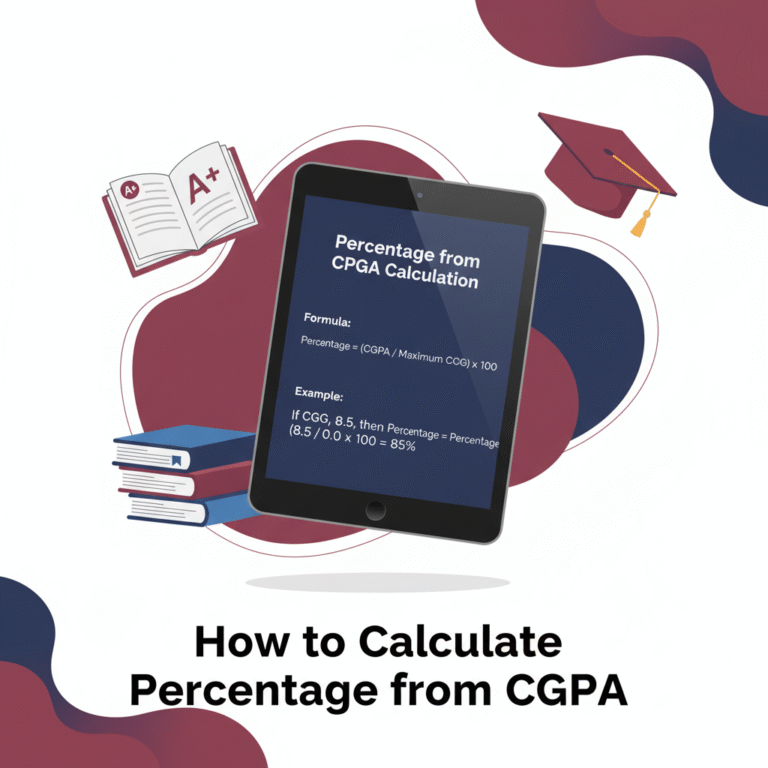
Percentage = CGPA × 10
This policy change was adopted to standardize conversion in the 2019 scheme. Other documents and legacy approximations may still be seen online, but for scheme-specific and recent transcript purposes, use the KTU-sanctioned conversion for your scheme. Always double-check your course regulation document. ece.cet.ac.in+1
Practical checklist: compute your CGPA confidently
To make sure your computation of how to calculate CGPA in KTU is accurate, follow this checklist:
- Gather official grade letters and credits for every registered course.
- Use the approved grade-point mapping (KTU 10-point scale). CCBP
- Include failed courses as per rules. KtuQbank
- Multiply grade point by course credit, sum for numerator.
- Sum credits (registered) for denominator.
- Divide and round according to college display rules.
- If converting to percentage, confirm the scheme-specific conversion rule (e.g., CGPA × 10 for 2019 scheme). ece.cet.ac.in
Example calculation: a two-semester cumulative CGPA
A compact walkthrough illustrating how to calculate CGPA in KTU:
Semester 1:
- Course 1: 4 credits, GP = 8.5 → 34.0
- Course 2: 3 credits, GP = 7.5 → 22.5
- Course 3: 2 credits, GP = 10 → 20.0
Semester 1 total grade points = 76.5; credits = 9 → SGPA1 = 76.5 / 9 = 8.5
Semester 2:
- Course 4: 4 credits, GP = 9 → 36.0
- Course 5: 3 credits, GP = 8 → 24.0
Semester 2 total grade points = 60.0; credits = 7 → SGPA2 = 60 / 7 ≈ 8.57
Cumulative:
- Total grade points = 76.5 + 60 = 136.5
- Total credits = 9 + 7 = 16
- CGPA = 136.5 ÷ 16 = 8.53125 → displayed as 8.53 (depending on rounding rules)
This concrete arithmetic exemplifies how to calculate CGPA in KTU using the standard weighted-average method. Use exact numbers for your own transcripts. ktugpa.web.app
How KTU’s grading system impacts academic policy and student outcomes
Knowing how to calculate CGPA in KTU is part of a larger conversation about assessment design and educational policy.
- Transparency and comparability: The numeric CGPA helps employers and higher-education evaluators compare students across colleges and schemes.
- Student mobility: A standardized CGPA formula facilitates transfers, admissions, and scholarship eligibility.
- Performance indicators: Institutions use aggregated CGPA statistics to evaluate program quality, curricular adequacy, and to inform reforms.
- Inclusive outcomes: Clear, credit-weighted measures ensure that technical, lab, and project-intensive courses (often critical to employability) are properly recognized.
On a state level, KTU’s rigorous credit-and-grade approach contributes to Kerala’s efforts in engineering education modernization and workforce readiness. This has knock-on benefits for rural development and local industry linkages as new graduates bring technological skills to state enterprises and startups. Framing how to calculate CGPA in KTU within policy and regional development underscores how an apparently technical formula supports larger social goals.
State-level implications: employability, access, and equity
KTU’s CGPA system ties into Kerala’s broader educational and economic policies:
- Employability metrics: Companies often screen candidates using CGPA; standardized calculations reduce bias from institution-specific grading quirks.
- Access and diversity: Transparent metrics make scholarship and placement processes more objective, aiding historically underrepresented groups, including women and rural students.
- Regional talent pipelines: Universities, colleges, and state policy coordinate to align curriculum and assessment with local industry needs, boosting rural job creation and entrepreneurship.
Thus, mastering how to calculate CGPA in KTU helps students navigate placement systems and policy-enabled opportunities that seek measurable academic indicators.
Success stories and real-world outcomes
Graduates who understand how to calculate CGPA in KTU and actively manage their academic portfolios frequently:
- Present precise CGPA figures for placements and higher-study applications, increasing clarity and trust.
- Use transcript-aware strategies—like prioritizing higher-credit courses—to optimize cumulative outcomes where reattempts are permitted.
- Benefit from university conversion consistency when applying to national/international programs because their records map predictably to percentage or GPA scales.
Institutes using KTU’s method have reported more straightforward placement shortlisting and reduced disputes over grade conversions during admissions processes. Several alumni networks also cite the clarity of the KTU CGPA/percentage policy as helpful in overseas applications. Cgpa Calculator+1
Challenges and criticisms around CGPA systems (and KTU’s responses)
While how to calculate CGPA in KTU is straightforward mathematically, several criticisms of CGPA systems are worth noting:
- Overemphasis on a single number: CGPA can overshadow project work, soft skills, and domain-specific accomplishments. Many institutions now complement CGPA with portfolios and micro-credentials.
- Course-structural bias: A program with many low-credit electives will compute differently from one weighted with high-credit capstones; credit design decisions therefore matter a lot.
- Conversion confusion: Legacy conversion rules (e.g., different approximations for CGPA→% seen online) created ambiguity. KTU’s move to formalize scheme-specific conversion (e.g., CGPA×10 for 2019 scheme) addresses this. ece.cet.ac.in+1
KTU and affiliated colleges mitigate these issues by maintaining transparent regulations, publishing scheme-specific guidance, and providing counseling to students on how transcript numbers are derived.
Comparisons: KTU versus other grading systems
If you already know how to calculate CGPA in KTU, you might be curious how it compares to other systems:
- US-style 4.0 GPA: US universities use a 4.0 scale where letter grades map to 4.0, 3.7, etc. Converting KTU’s 10-point CGPA to a 4.0 equivalent depends on mapping conventions; many conversion tools exist but treat conversions as approximate. AP Guru
- Other Indian universities: Several Indian universities use similar credit-weighted GPAs but differ in letter-to-grade-point mappings and percentage conversion rules. KTU’s 10-point scale is common but not universal; always check scheme rules. Scholaro
The core similarity: the weighted average concept is broadly adopted; the key differences are in grade-to-point mapping and policy rules on repeats and conversion.
Tools and calculators: automating the process
After learning how to calculate CGPA in KTU by hand, many students use online calculators for convenience. These tools implement the same formula (CGPA = Σ(C × GP)/ΣC) and often let you:
- Enter course credits and grade letters, converting them to grade points automatically.
- Compute SGPA for a semester and cumulative CGPA across semesters.
- Convert to percentage following scheme-specific rules (when available).
Use reputable tools tied to KTU guidance or official college calculators when possible, and cross-check with manual arithmetic for verification. ktugpa.web.app+1
Best practices for students — improving your CGPA responsibly
Understanding how to calculate CGPA in KTU is only part of success. Here are practical, ethical strategies:
- Plan by credits: Prioritize doing well in high-credit courses; their impact on CGPA is proportional.
- Address failures early: Since failed courses can drag down CGPA, retake or remediate promptly when permitted.
- Keep meticulous records: Maintain a personal ledger of credits and grade points to verify university results.
- Use counseling: Ask exam cells about how repeats and improvements are treated so you can plan.
- Document projects and internships: Complement a numerical CGPA with demonstrable skills and portfolios for placements.
These practices help students present a strong holistic profile beyond the number produced when they calculate how to calculate CGPA in KTU.
Future prospects and evolving practices
The academic ecosystem is evolving, and so are ways to measure performance. How might how to calculate CGPA in KTU change or be augmented in the future?
- Micro-credentials and block-based credits: As curricula modularize, credit systems may adapt, requiring clearer aggregation rules.
- Skill-weighted recognition: Industry-aligned assessments might sit beside CGPA to produce richer graduate profiles.
- Digital transcripts: Machine-readable transcripts with standardized CGPA and metadata will simplify cross-border recognition.
- Policy harmonization: State and national policies could further standardize conversion conventions, reducing confusion for students across schemes.
KTU’s past adjustments (for example, formalizing conversion rules for some schemes) show the system’s capacity to adapt in response to stakeholder needs. ece.cet.ac.in
Frequently Asked Questions (FAQs)
Final checklist and quick reference (condensed)
- Formula: CGPA = Σ(C × GP) ÷ ΣC. jawaharlalcolleges.com
- Use KTU’s 10-point grade mapping for GP values. CCBP
- Include all registered credits and failed courses unless scheme rules state otherwise. KtuQbank
- For conversion to percentage, check your scheme’s regulation; recent KTU guidance for certain schemes uses Percentage = CGPA × 10. ece.cet.ac.in
Closing thoughts
Knowing how to calculate CGPA in KTU is more than an arithmetic skill — it’s a practical literacy that empowers students to manage academic goals, present accurate records to employers and universities, and make informed decisions about which courses to prioritize. The credit-weighted formula is simple, fair, and widely used: multiply grade points by course credits, sum, and divide by total credits.
Beyond calculation, engage with your college’s exam office to learn scheme-specific rules about repeats, rounding, and percentage conversion. This will ensure that the number you compute aligns with the official transcript — and that your academic record tells the true story of your preparation and potential.
Sources and further reading
Selected authoritative sources and practical tools consulted while preparing this guide (used above for factual points and conversion guidance): KTU scheme and conversion documents, practical KTU CGPA guides, and university notices explaining conversion updates. For the key procedural points and the conversion rule mentioned here, see APJ Abdul Kalam Technological University’s guidance and referenced college regulation notices. ktugpa.web.app+4jawaharlalcolleges.com+4ece.cet.ac.in+4
If you’d like, I can:
- Walk through your actual semester grades and compute your CGPA step-by-step here; or
- Provide a downloadable spreadsheet template that automates how to calculate CGPA in KTU for all semesters; or
- Show how to convert a KTU CGPA to other international GPA scales with worked examples.