How to Calculate CGPA from GPA: A Comprehensive Guide for Students, Institutions, and Policymakers
Converting semester GPAs into a cumulative grade point average (CGPA) is a routine yet pivotal activity in academic life. Whether you are a student applying for higher studies, an administrator standardizing records, or a policymaker evaluating education outcomes, knowing how to calculate CGPA from GPA accurately and transparently matters. This long-form article explains the concept, walks through practical methods, offers worked examples, situates the calculation in historical and policy contexts, explores state-level and social impacts (including regional impact, policy framework, state-wise benefits, women empowerment schemes, rural development and social welfare initiatives), describes common challenges, compares alternative grading systems, and looks ahead to future prospects. The aim is to provide an authoritative, competitor-beating resource that you can rely on.
Introduction: Why the Question “How to Calculate CGPA from GPA” Matters
Students frequently ask how to calculate CGPA from GPA when they try to summarize their academic performance across semesters. Employers and graduate programs ask for CGPA for quick screening. Institutions must ensure that conversions are fair, consistent, and defensible. Beyond individual records, properly computed CGPA figures feed into larger analyses — institutional rankings, scholarship eligibility, and policy assessment — making the conversion method an instrument of broader regional impact and policy framework considerations.
Understanding how to calculate CGPA from GPA also helps reduce disputes, enables equitable access to state-wise benefits (such as scholarships and fellowships), and supports transparency in women empowerment schemes and rural development programs that include educational metrics.
Core Concepts: What Is GPA and What Is CGPA?
A clear understanding of the two terms is essential before discussing how to calculate CGPA from GPA.
GPA (Grade Point Average) usually refers to the average performance within a single term or semester. It is commonly calculated on a numeric scale — for instance, 4.0 (U.S. scale), 10.0 (some Indian universities), or 5.0 in other contexts. Each course contributes a grade point, often derived from the letter grade, and those values are averaged to produce the semester GPA.
CGPA (Cumulative Grade Point Average) aggregates academic performance across multiple terms. The CGPA summarizes a student’s overall academic record from the start of the program until the point of calculation. When institutions ask how to calculate CGPA from GPA, they usually expect a method that combines multiple semester GPAs into a single cumulative figure that reflects the academic weighting of courses or terms.
A Brief History: How Grading Systems and the Question “How to Calculate CGPA from GPA” Evolved
Modern grade-point systems evolved in the 20th century as higher education expanded and quantification of performance became necessary for comparisons across institutions and programs. Early systems were simple percentage-based evaluations. As curricula diversified, educational institutions introduced GPA scales to standardize evaluation across different grading patterns.
The question how to calculate CGPA from GPA emerged naturally: as students completed multiple semesters, institutions needed a standard method to aggregate term-wise GPAs. Over time, multiple approaches (simple averaging, credit-weighted averaging, and scale normalization) became part of institutional practice. Differences among universities, regions, and nations prompted the rise of conversion guidelines and policy frameworks to ensure fairness and consistency — especially where students move between institutions or cross national borders for higher education or employment.
Objectives: Why a Clear Method for Calculating CGPA from GPA Is Important
When determining how to calculate CGPA from GPA, institutions and stakeholders generally pursue several objectives:
- Accuracy: The CGPA must reflect genuine academic performance.
- Fairness: Students across different programs and credit loads should be treated equitably.
- Transparency: Methods should be easy to audit and explain.
- Portability: CGPA should be comparable across institutions, regions, and systems.
- Policy alignment: Conversion methods must support state-wise benefits, scholarship eligibility, and social welfare initiatives.
Clear methods for how to calculate CGPA from GPA help educational administrators administer scholarships, enable employers to make meaningful comparisons, and assist policymakers when tying educational benefits to measurable academic performance.
Standard Methods: How to Calculate CGPA from GPA (Step-by-Step)
There is no single universal rule, but three standard methods are widely used. Below each method, I explain step-by-step how to calculate CGPA from GPA.
1) Simple (Unweighted) Average Method
This method applies when each semester is treated equally — typically in programs where credit load per semester is constant.
Steps to calculate CGPA from GPA (simple average):
- List the GPA for each completed semester.
- Add them together.
- Divide the sum by the number of semesters.
Formula:
CGPA=GPA1+GPA2+⋯+GPAnn\text{CGPA} = \frac{GPA_1 + GPA_2 + \dots + GPA_n}{n}CGPA=nGPA1+GPA2+⋯+GPAn
Example:
If semester GPAs are 3.4, 3.7, 3.2, 3.8, then:
Sum = 3.4 + 3.7 + 3.2 + 3.8 = 14.1
CGPA = 14.1 / 4 = 3.525
This straightforward approach answers how to calculate CGPA from GPA in programs with balanced credit distributions.
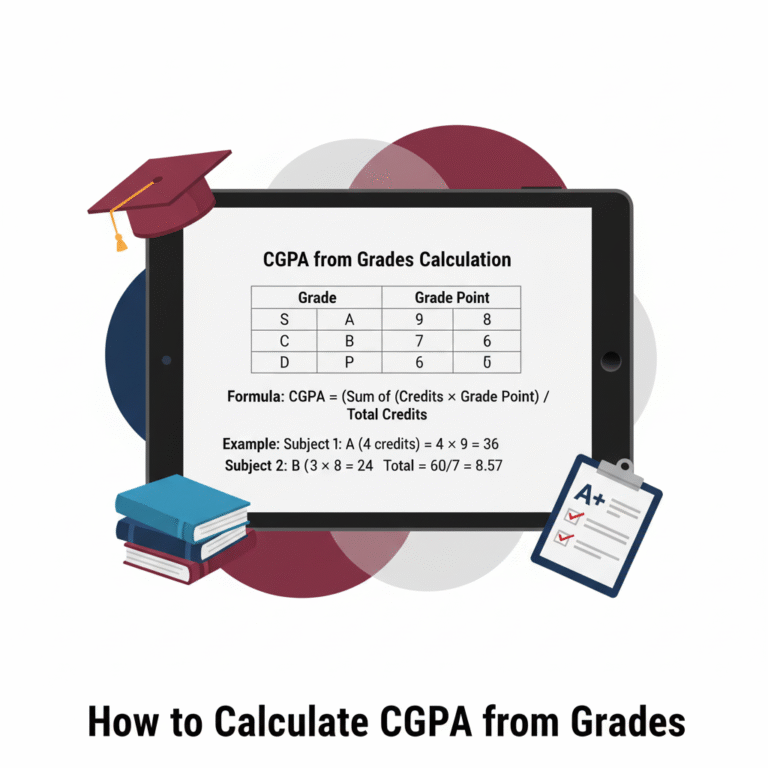
2) Credit-Weighted Average Method (Most Common and Recommended)
Most reputable institutions adopt credit-weighted averaging because courses and semesters can differ in credit load. This is the robust method for how to calculate CGPA from GPA.
Steps to calculate CGPA from GPA (credit-weighted):
- For each semester, determine the total credits attempted and the semester GPA.
- Multiply each semester GPA by its semester credit total to get “grade points” for that semester.
- Sum all the semester grade points.
- Sum all the credits attempted across semesters.
- Divide the sum of grade points by the sum of credits.
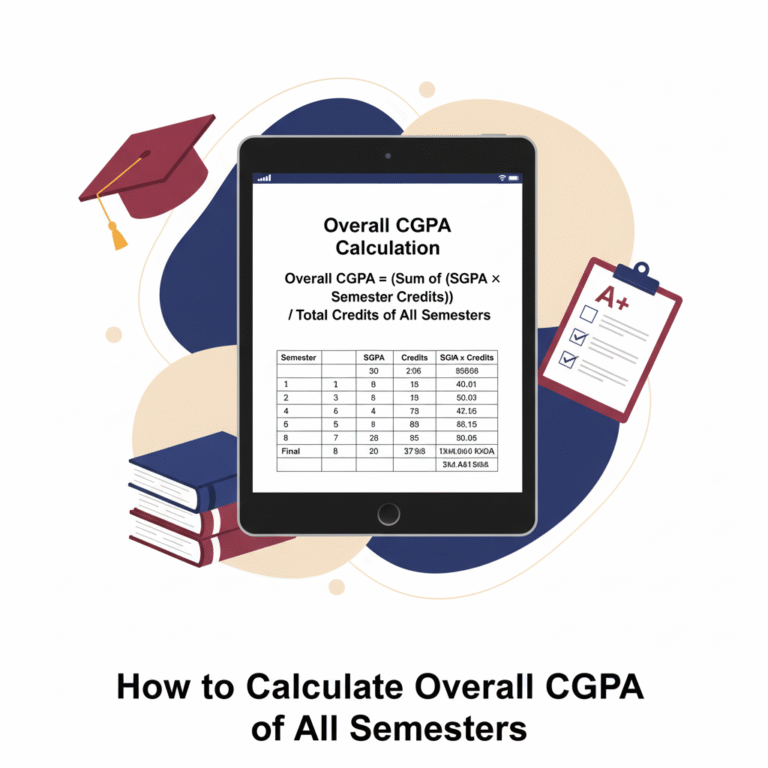
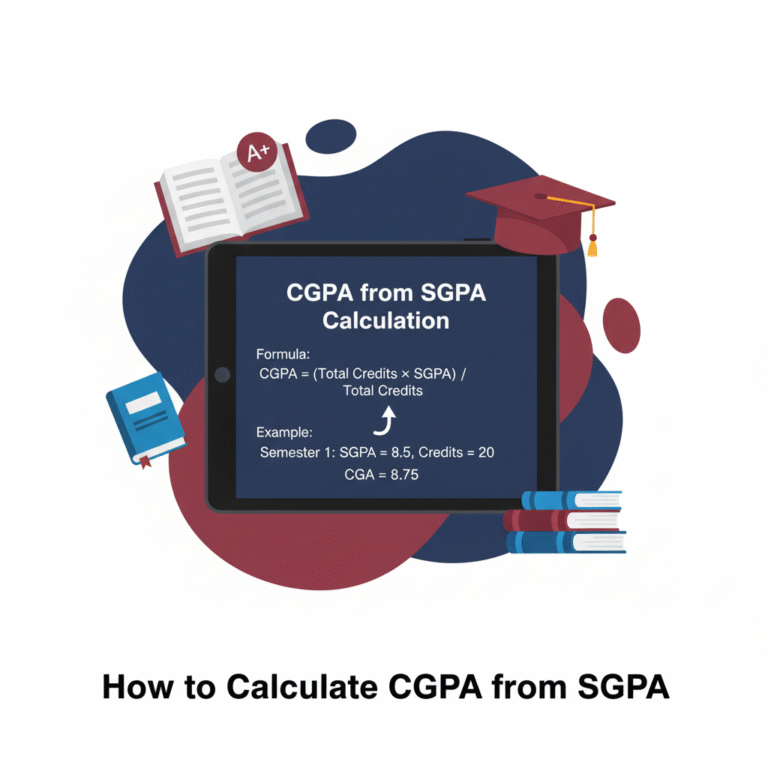
Formula:
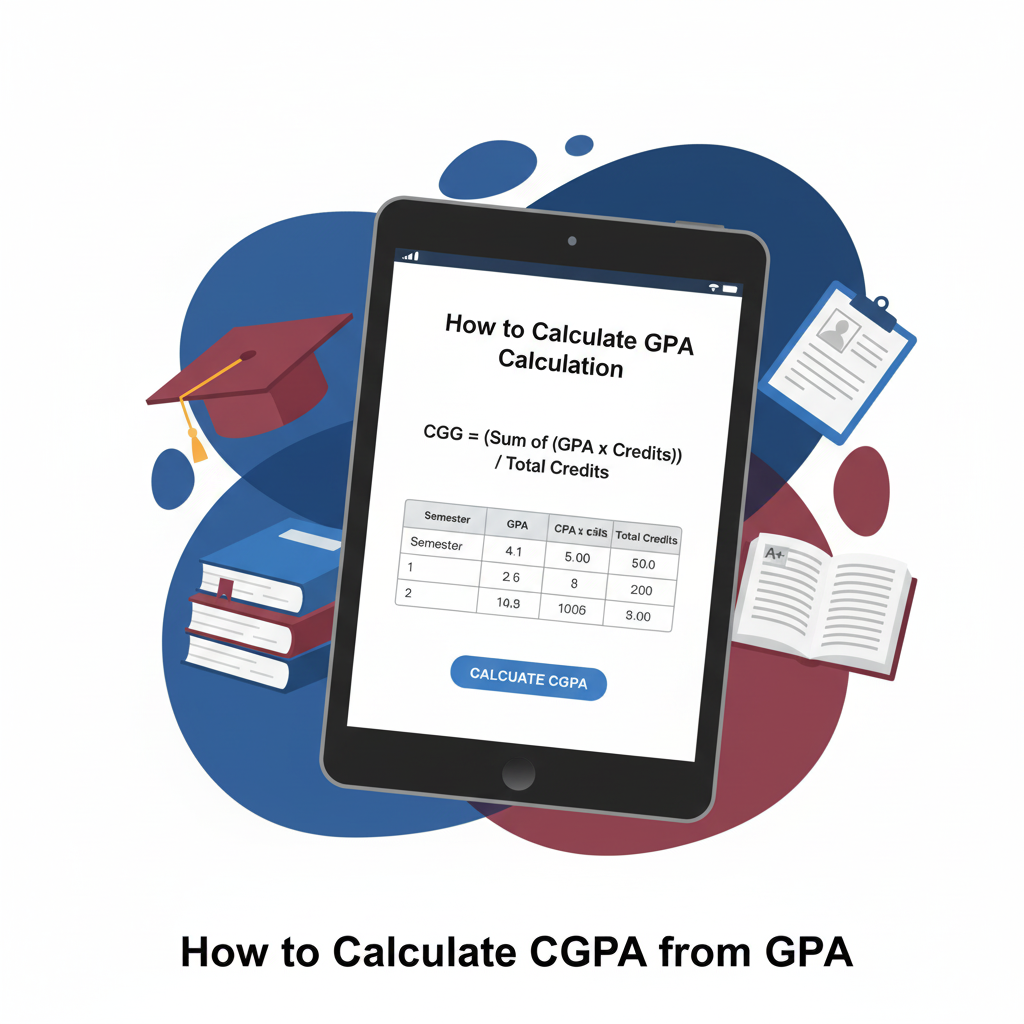
CGPA=∑i=1n(GPAi×Creditsi)∑i=1nCreditsi\text{CGPA} = \frac{\sum_{i=1}^{n} (GPA_i \times Credits_i)}{\sum_{i=1}^{n} Credits_i}CGPA=∑i=1nCreditsi∑i=1n(GPAi×Creditsi)
Example:
- Semester 1: GPA = 3.6, Credits = 18 → 3.6 × 18 = 64.8
- Semester 2: GPA = 3.2, Credits = 20 → 3.2 × 20 = 64.0
- Semester 3: GPA = 3.8, Credits = 16 → 3.8 × 16 = 60.8
Sum grade points = 64.8 + 64.0 + 60.8 = 189.6
Sum credits = 18 + 20 + 16 = 54
CGPA = 189.6 / 54 = 3.511111… → typically rounded to two or three decimal places (e.g., 3.511)
This method gives a reliable and defensible answer to how to calculate CGPA from GPA across varying workloads.
3) Scale Conversion + Weighted Method (When GPAs Use Different Scales)
Sometimes a student has GPAs recorded on different scales (for example, some semesters on a 4.0 scale and some on a 10.0 scale due to exchange programs or institutional idiosyncrasies). In such cases, determining how to calculate CGPA from GPA requires normalization.
Steps:
- Normalize each semester GPA to a common scale (e.g., convert 10.0-scale scores to 4.0-scale equivalents using an agreed conversion table or formula).
- Apply the credit-weighted method after normalization.
Example normalization approach:
- If using a linear conversion from a 10-point to a 4-point scale: GPA_4 = (GPA_10 / 10) × 4
- Then follow the credit-weighted method.
Caution: Conversions can vary; institutions must publish and defend the conversion formula as part of the policy framework.
Practical Worked Example: Exactly How to Calculate CGPA from GPA (Credit-Weighted with Numbers)
Let’s walk through a complete, precise example to demonstrate how to calculate CGPA from GPA methodically.
Assume a student completed five semesters with a mix of credit loads and GPAs:
- Semester 1: GPA = 3.50, Credits = 17
- Semester 2: GPA = 3.75, Credits = 18
- Semester 3: GPA = 3.20, Credits = 16
- Semester 4: GPA = 3.90, Credits = 20
- Semester 5: GPA = 3.60, Credits = 19
Step 1: Multiply each GPA by credits
- S1: 3.50 × 17 = 59.50
- S2: 3.75 × 18 = 67.50
- S3: 3.20 × 16 = 51.20
- S4: 3.90 × 20 = 78.00
- S5: 3.60 × 19 = 68.40
Step 2: Sum grade points = 59.50 + 67.50 + 51.20 + 78.00 + 68.40 = 324.60
Step 3: Sum credits = 17 + 18 + 16 + 20 + 19 = 90
Step 4: CGPA = 324.60 / 90 = 3.606666… Rounded to three decimals = 3.607
This example demonstrates how to calculate CGPA from GPA precisely and transparently.
Rounding, Display, and Institutional Policies
Institutions often specify how CGPA is rounded and displayed. Common conventions include:
- Rounding to two decimal places (e.g., 3.61).
- Rounding to three decimal places where precision matters (e.g., scholarship cut-offs).
- Truncation instead of rounding (less common and should be stated publicly).
When implementing rules for how to calculate CGPA from GPA, institutions should explicitly state rounding rules in their policy framework to avoid disputes. This policy clarity ties into broader issues like state-wise benefits, where a decimal difference can determine eligibility.
When Percentages and Grades Enter the Picture: Converting Percentage to CGPA or GPA
Sometimes records are in percentage marks rather than GPAs. In those situations, the approach to how to calculate CGPA from GPA depends on an initial conversion from percentage to GPA.
Common conversion approach:
- Convert percentage to grade point (e.g., map 90–100% → 4.0, 80–89% → 3.5, etc.), or use a linear mapping: GPA = (Percentage / 100) × ScaleMax.
- Once each term’s grade point is determined, use the credit-weighted formula to calculate CGPA.
Note: Because conversion bands vary by institution and country, any conversion method must be recorded in institutional policy to support fairness and portability.
Institutional Implementation: Best Practices
For universities and colleges deciding how to calculate CGPA from GPA, recommended practices include:
- Publish a transparent formula: Define whether simple average or credit-weighted average is used.
- Handle different scales explicitly: Provide conversion tables where necessary.
- Define rounding rules: State them clearly in transcripts and handbooks.
- Automate calculations: Use reliable student information systems to avoid manual errors.
- Audit trails: Store the inputs and formula used for each transcript to enable verification.
These measures improve trust and make calculations defensible to external bodies, employers, and government agencies overseeing state-wise benefits and social welfare initiatives.
State-Level Impact and Policy Frameworks
Although calculating CGPA from GPA is often a technical institutional matter, it intersects with public policy in multiple ways.
Scholarship and State-Wise Benefits
Many regional scholarships and state-wise benefits use CGPA thresholds for eligibility. A clear and fair method for how to calculate CGPA from GPA ensures that such programs target the intended beneficiaries — especially in programs promoting women empowerment schemes, supporting students from rural development initiatives, or delivering social welfare initiatives that include educational incentives.
Data for Regional Impact Assessments
Aggregated CGPA data helps measure educational outcomes across districts and states. Policymakers use these metrics to identify target areas for investment, make decisions about teacher training, and evaluate the effectiveness of programs aimed at increasing access to higher education.
Policy Frameworks and Standardization
To reduce fragmentation, some ministries and accreditation bodies recommend standard methods for how to calculate CGPA from GPA, or at least require institutions to publish conversion policies. Standardization facilitates inter-state mobility and fairness in awarding state-sponsored benefits.
Equity Considerations: Women Empowerment Schemes and Rural Development
When CGPA calculations determine access to scholarships or placement in women empowerment schemes, precision and fairness matter. For instance:
- If rural students take fewer credits in early semesters due to resource constraints, a simple average may unfairly penalize them — a credit-weighted CGPA is fairer.
- Where state-wise benefits require a minimum CGPA threshold, rounding policies should avoid inadvertently excluding marginal candidates.
Designing a policy for how to calculate CGPA from GPA must therefore be sensitive to equity considerations, ensuring that grading methods do not perpetuate structural disadvantages.
Success Stories: Institutions and Regions That Got It Right
Several institutions and states have improved educational outcomes by focusing on transparent, student-centered CGPA calculation policies. Success stories typically share common features:
- Clear, public guidelines on how to calculate CGPA from GPA.
- Automated, audited systems for transcript generation.
- Outreach programs that explain grading and conversion to students and parents.
- Linking data analytics to policy interventions that boost regional impact, such as directing additional resources to districts with lower cumulative performance.
Such efforts help ensure that educational metrics support, rather than hinder, social welfare initiatives and women empowerment schemes.
Challenges and Common Pitfalls When Determining CGPA from GPA
Even with standard formulas, real-world complications arise:
- Mixed scales: Students who transfer from institutions with different scales create conversion challenges.
- Variable credit systems: Differences in credit assignment across programs require thoughtful weighting.
- Incomplete records: Missing transcripts or unrecorded internships can misstate cumulative performance.
- Rounding disputes: Small differences due to rounding can have outsized consequences for scholarships and honors.
- Transparency gaps: If institutions do not publicize how to calculate CGPA from GPA, students and employers may mistrust transcripts.
Addressing these challenges requires institutional policies, outreach, and sometimes state-level regulation.
Comparisons: CGPA/GPA vs Percentage and Letter Grade Systems
Why insist on grade points and CGPA at all? Comparing systems helps answer how to calculate CGPA from GPA in context:
- Percentage system: Intuitive but can be inconsistent across institutions and courses with different difficulty. Converting percentage to CGPA typically requires normalization.
- Letter grade system: Widely understood, but letter-to-point mapping must be standardized to answer how to calculate CGPA from GPA.
- Grade Point systems (GPA/CGPA): Provide numeric comparability and are easier to aggregate and analyze.
Each system has trade-offs. When multiple systems coexist, explicit conversion rules are essential to answer how to calculate CGPA from GPA consistently.
Technology and Automation: Making “How to Calculate CGPA from GPA” Foolproof
Student information systems can automate CGPA calculations, reducing errors and ensuring reproducibility. Best practices for automation:
- Store GPAs and credit data per semester.
- Implement the chosen formula (simple or credit-weighted).
- Keep logs of calculation steps.
- Provide downloadable transcripts with clear formula disclosure.
Automation also supports transparency before policy-makers who rely on aggregated data for regional impact assessments and social welfare programming.
Ethical and Governance Considerations
When deciding how to calculate CGPA from GPA, institutions must act ethically:
- Avoid manipulative rounding practices that artificially inflate or deflate scores.
- Provide appeals mechanisms for students to contest calculation errors.
- Ensure conversion tables are applied consistently, without favoritism.
Good governance fosters trust among students, employers, and policymakers, especially where CGPA figures influence eligibility for state-wise benefits, scholarships, and women empowerment schemes.
International Mobility: Converting CGPA/GPA Between Countries
International applications often require conversions. For foreign admissions or job applications, applicants and institutions must clarify how to calculate CGPA from GPA and supply supporting documentation. Common approaches include:
- Use recognized credential evaluation services.
- Provide both original transcripts and a statement explaining the institution’s calculation method.
- Where possible, publish conversion tables to assist credential evaluators.
The clarity of how to calculate CGPA from GPA streamlines mobility and prevents misunderstandings that can disrupt students’ academic or professional progress.
Monitoring, Evaluation, and Using CGPA Data for Policy
Aggregated CGPA data serves as evidence in monitoring education interventions. Examples:
- Measuring the effects of teacher training on cumulative student performance.
- Evaluating impacts of rural development programs on higher education outcomes.
- Assessing the effectiveness of women empowerment schemes that include academic components.
For these uses, the method for how to calculate CGPA from GPA must be stable and well-documented so that time-series analyses are meaningful.
Future Prospects: Where Conversions and CGPA Use Are Heading
Looking ahead, several trends will shape how institutions approach how to calculate CGPA from GPA:
- Greater standardization: Accreditation bodies may push for standardized conversion practices across regions to facilitate mobility.
- Sophisticated analytics: Robust CGPA data will feed machine-learning systems for early warning of student risk and targeted interventions.
- Holistic assessment models: Systems may complement CGPA with competency-based assessments and micro-credentials, requiring new aggregation rules.
- Policy integration: State-level programs tracking educational progress may incorporate CGPA metrics into broader development indicators.
The future will favor transparent, auditable, and student-centered methods for how to calculate CGPA from GPA.
Practical Checklist: Institutional Policy for “How to Calculate CGPA from GPA”
For institutions drafting or revising policy, here’s a practical checklist:
- State the formula (simple average vs credit-weighted).
- Publish conversion tables for mixed scales.
- Define rounding and truncation rules.
- Automate calculations with an audit trail.
- Train staff to explain methods to students.
- Align the method with scholarship and state-wise benefits criteria.
- Provide an appeals process for disputes.
Implementing such policies ensures the institution’s approach to how to calculate CGPA from GPA is defensible and equitable.
Conclusion: Making “How to Calculate CGPA from GPA” Work for Everyone
Answering how to calculate CGPA from GPA is both a technical and a policy question. The credit-weighted averaging method generally provides the fairest and most accurate result. Whatever method an institution chooses, it should be transparent, consistent, and aligned with broader objectives — from enabling individual student success to informing state-wide educational policies and social welfare initiatives. By following best practices, institutions and policymakers can use CGPA reliably to support regional impact, education equity, women empowerment schemes, rural development, and social welfare initiatives.