How to Calculate CGPA in VTU – Step-by-Step Student Guide
Understanding how to calculate CGPA in VTU is essential for every student enrolled under Visvesvaraya Technological University. This guide explains the process step-by-step, covering history, objectives, implementation, state-level implications, comparative frameworks, success stories, challenges, and future prospects. Whether you are a first-year engineer trying to understand semester results or a faculty member advising students, this long-form article will equip you with the clarity and confidence needed to compute and interpret CGPA in VTU accurately and meaningfully.
Introduction: Why knowing how to calculate CGPA in VTU matters
Academic grading is more than a number; it shapes career choices, scholarship eligibility, and institutional reputation. Learning how to calculate CGPA in VTU enables students to forecast their standing, plan for improvement, and understand eligibility for placements and higher education. The CGPA (Cumulative Grade Point Average) system used by VTU standardizes student performance across semesters and branches, translating marks into grade points and aggregating them in a weighted fashion. This article unpacks the system in clear, professional terms and situates it within broader educational policy frameworks, regional impacts, and future trends.
A brief history of grading at VTU and the rise of CGPA
Visvesvaraya Technological University introduced a structured, credit-based grading system to align engineering education with global standards. Historically, raw marks dominated assessments, but the transition to grade points and CGPA reflected a desire for normalization across subjects, semesters, and institutions. When discussing how to calculate CGPA in VTU, it helps to remember that the system evolved to reduce variability that raw marks alone could not address — aiming for fairness, comparability, and mobility of students across academic contexts.
Understanding the components: credits, grade points, and semesters
Before learning how to calculate CGPA in VTU, you must understand three building blocks: credits, grade points, and semesters. Each course or subject is assigned a credit value reflecting contact hours and workload. After evaluation, each student receives a grade, which maps to a grade point per VTU’s grading scheme. The Semester Grade Point Average (SGPA) is a weighted average of these grade points using credits as weights. The CGPA is the cumulative weighted average across all semesters up to the point of calculation.
The VTU grading scale (conceptual overview)
VTU employs a grade-to-point mapping where letter grades correspond to numeric grade points. Although specific numeric cutoffs can be updated by the university, the conceptual mechanism is constant: higher marks translate to higher grade points; these grade points are multiplied by subject credits to produce weighted contributions. When calculating how to calculate CGPA in VTU, students must use the VTU-prescribed grade points for the specific examination period because minor policy updates can alter cutoffs or mappings.
Step-by-step: how to calculate CGPA in VTU (practical method)
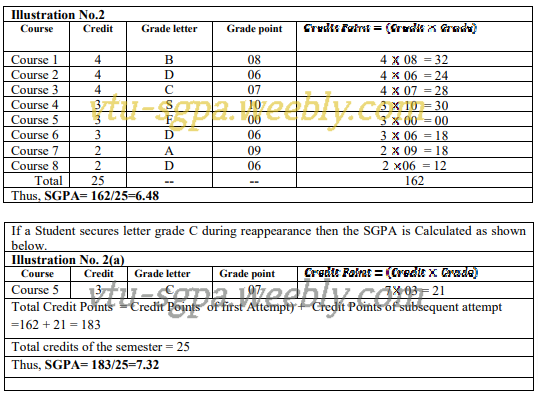
- Record every course taken in a semester along with its credit value and the grade obtained.
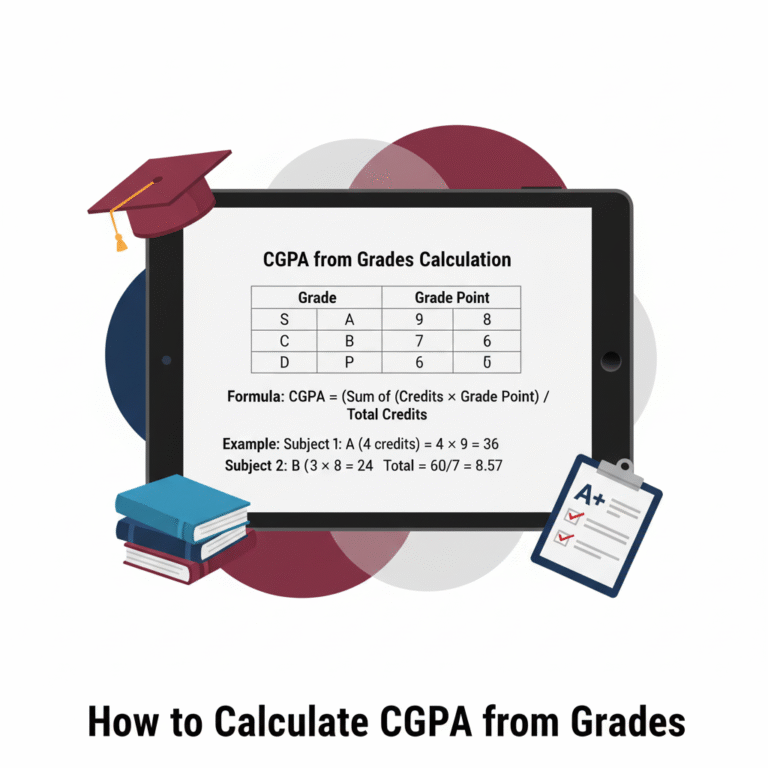
- Convert each grade into the corresponding VTU grade point.
- Multiply the grade point of each course by the course’s credit to get the weighted grade points.
- Sum the weighted grade points for all courses in the semester to get the total weighted grade points.
- Sum the credits for all courses in the semester to get total credits for the semester.
- Divide the total weighted grade points by the total credits to obtain the SGPA for that semester.
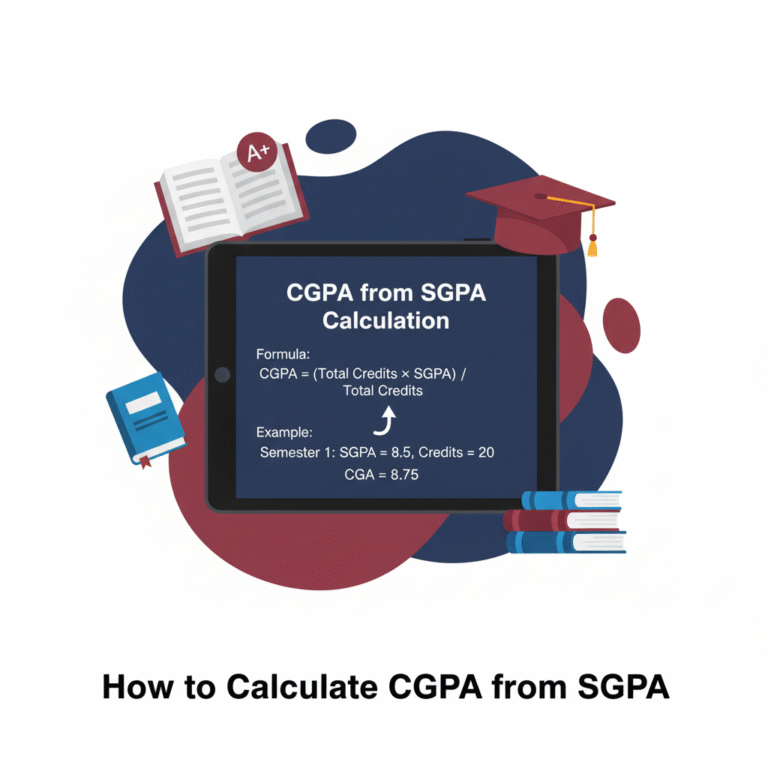
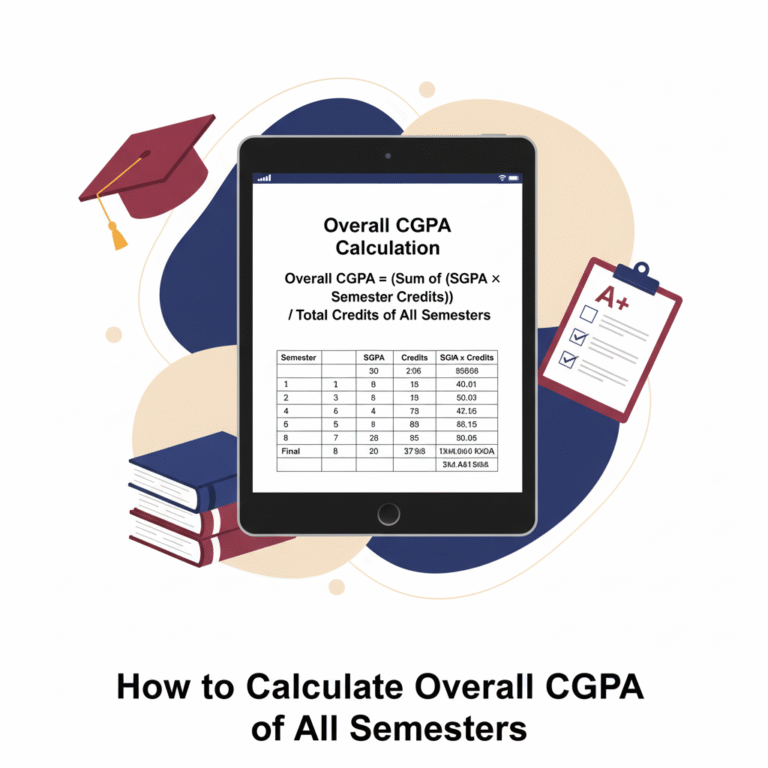
- To compute CGPA at any point, repeat the weighted-sum method cumulatively across all semesters: sum all weighted grade points across semesters and divide by the total credits accumulated.
This stepwise approach answers the core question of how to calculate CGPA in VTU in a transparent manner enabling replication and verification.
Worked example: calculating SGPA and CGPA
Imagine a semester with these courses and results:
- Course A: 4 credits, Grade A (grade point 9)
- Course B: 3 credits, Grade B (grade point 8)
- Course C: 3 credits, Grade C (grade point 7)
- Course D: 2 credits, Grade A (grade point 9)
First, compute weighted grade points:
Course A: 4 × 9 = 36
Course B: 3 × 8 = 24
Course C: 3 × 7 = 21
Course D: 2 × 9 = 18
Total weighted grade points = 36 + 24 + 21 + 18 = 99
Total credits = 4 + 3 + 3 + 2 = 12
SGPA = 99 ÷ 12 = 8.25
To find CGPA after two semesters, you would add the weighted grade points and credits from both semesters and divide accordingly. This numeric demonstration clarifies how to calculate CGPA in VTU in day-to-day situations.
Important nuances: elective credits, audit courses, and practicals
When calculating how to calculate CGPA in VTU, remember that not all credits may affect CGPA equally. Electives, audit courses, and pass/fail components sometimes have different treatment. For example, audited courses often don’t carry credit toward CGPA, and practicals may have different credit-weighting mechanisms. Always refer to the specific academic regulations for your batch and year because VTU occasionally updates how these variants are treated. Being aware of these nuances prevents miscalculation and misinterpretation.
Implementation: how VTU presents results and transcripts
VTU’s official transcripts typically show SGPA per semester and a CGPA cumulative figure. These documents summarize course codes, credits, grades, and grade points, enabling transparent verification of how to calculate CGPA in VTU. Universities also often publish formulae and sample calculations within their academic regulations or student handbooks; consulting these official resources ensures your manual calculations align with administrative computations.
Why CGPA matters: objectives and student outcomes
The objective behind explaining how to calculate CGPA in VTU goes beyond arithmetic. CGPA is used to determine class/division, eligibility for scholarships, higher study admissions, and placement shortlisting. Employers and postgraduate programs frequently use CGPA as a comparability tool. A well-understood CGPA system empowers students to set measurable improvement goals, seek timely academic support, and plan course loads strategically to maximize learning and performance.
Regional impact: VTU’s grading on Karnataka’s student ecosystem
VTU’s approach to grading influences the student ecosystem across Karnataka. Knowing how to calculate CGPA in VTU allows regional stakeholders—students, colleges, training centers, and policymakers—to align career counseling, upskilling programs, and scholarship allocations with realistic academic metrics. When students comprehend CGPA mechanics, they can better navigate state-level academic schemes, fee-waiver policies, and targeted initiatives aimed at improving retention and employability in underserved regions.
Policy framework and institutional alignment
Understanding how to calculate CGPA in VTU must be paired with awareness of the policy framework that governs grading. VTU’s academic regulations define credit structures, grade mappings, revaluation processes, and provisions for backlogs and repeat examinations. Institutions affiliated to VTU implement these rules, and any institutional-level student support systems—remedial classes, tutoring, or mental health services—must operate within this policy frame to meaningfully impact CGPA outcomes.
State-wise benefits and educational equity
Although VTU is based in Karnataka, its grading policies and the clarity on how to calculate CGPA in VTU have implications for students migrating between states. Clear CGPA computation practices support portability for scholarships, inter-university transfers, and national-level placements. Further, consistent application of grading norms aids in assessing state-wise educational outcomes, informing targeted interventions to address gaps in rural college resources or to reward high-performing clusters.
Women empowerment and inclusion through transparent grading
Transparent knowledge of how to calculate CGPA in VTU can contribute indirectly to women empowerment in higher education. When grading is clear and standardized, female students—who may face additional societal or logistical challenges—can more readily plan academic catch-up strategies, apply for gender-focused scholarships, and access mentoring programs. Accurate CGPA calculation supports fair evaluation and reduces ambiguity that sometimes disproportionately affects marginalized groups.
Rural development and CGPA clarity
For students from rural backgrounds, understanding how to calculate CGPA in VTU demystifies academic progression and helps community stakeholders—schools, local NGOs, and training centers—to design interventions that build academic confidence. Clear CGPA metrics can also attract state and private investments to rural institutions by highlighting areas needing infrastructure or faculty development, bridging urban-rural disparities in engineering education outcomes.
Social welfare initiatives and academic grading
State and central governments often design social welfare schemes that include educational components such as fee reimbursements or stipends conditioned on academic performance. A precise understanding of how to calculate CGPA in VTU ensures eligible students benefit correctly from these schemes. In turn, administrators designing welfare programs can more fairly set thresholds and performance-based incentives by relying on robust CGPA metrics.
Success stories: how CGPA clarity transformed student journeys
Across VTU-affiliated colleges, there are many instances where students used knowledge of how to calculate CGPA in VTU to strategically enhance outcomes. For example, students who identify low-weight, high-impact subjects early can focus effort strategically; others leverage transparent SGPA tracking to decide when to attempt supplementary exams. Colleges that train students in grade-point calculations and study planning often report improved placement metrics and higher scholarship uptake—illustrating the real-world benefits of clarity around CGPA.
Challenges: common pitfalls in CGPA calculation and interpretation
Despite the straightforward formula, students encounter pitfalls when learning how to calculate CGPA in VTU. These include misunderstanding credit weights, misapplying grade mappings from different academic years, ignoring practical or lab assessment weightings, and failing to account for revaluation or supplementary exam rules. Additionally, students sometimes overemphasize CGPA at the expense of skill development; while CGPA is important, balanced academic and extracurricular growth yields better long-term outcomes.
Revaluation, supplementary exams, and their impact on CGPA
VTU’s rules for revaluation and supplementary exams can change a student’s CGPA retroactively. When a paper is revalued and the grade is improved, the weighted grade points for that course may alter, affecting the SGPA and thus the CGPA. Understanding how to calculate CGPA in VTU means also understanding the administrative timeline: when revised marks are reflected in transcripts, how backlogs are integrated into cumulative calculations, and how repeat course credits are treated. These administrative nuances materially affect academic planning.
Comparing VTU’s CGPA to other grading systems
When evaluating how to calculate CGPA in VTU, it’s instructive to compare VTU’s approach with other Indian universities or international systems. Some universities use percentage systems, while many Indian institutions now follow credit-based CGPA schemes similar to VTU. Internationally, systems like GPA in the U.S. use a 4.0 scale, while VTU uses its own grade point scale. Converting CGPA between systems requires careful mapping of grade points and cutoffs, especially for admissions abroad. Students should consult credential evaluation services or target institutions’ international offices when making conversions.
Practical advice: routines and tools for accurate calculation
To efficiently track how to calculate CGPA in VTU, adopt routines and tools. Maintain a semester-wise spreadsheet with course codes, credits, grades, and calculated weighted grade points. Recompute SGPA and CGPA after each result release, and cross-check with official transcripts. Many colleges provide student portals displaying SGPA and CGPA; use these to verify your manual calculations. Consistent record-keeping reduces anxiety and prevents errors when planning re-exams or applying for scholarships.
Role of faculty and institutions in guiding CGPA literacy
Faculty and college administrations play a pivotal role in ensuring students know how to calculate CGPA in VTU. Integrating a short orientation on credit systems, grade mapping, and CGPA computation in the first semester helps demystify the grading process. Faculty can also provide periodic academic audits for students with low SGPA, offering structured improvement plans. Institutional transparency in publishing grade mappings and sample calculations reduces misunderstandings and aligns expectations.
Technology and digital transformation in grade reporting
Digital tools simplify how to calculate CGPA in VTU by automating grade-to-point conversions and providing instant SGPA and CGPA computations. Student portals that show breakdowns by course, semester, and cumulative totals shrink the space for manual errors. As VTU and affiliated institutions digitize further, automated analytics can offer predictive insights, e.g., projecting projected CGPA based on current grades—empowering students to target specific improvements.
Legal and accreditation perspectives
For accreditation bodies and legal compliance, clarity on how to calculate CGPA in VTU is crucial. Accreditation assessments consider whether universities apply their grading policy consistently and transparently. Accurate CGPA calculations underpin claims about pass percentages, class distributions, and program outcomes used in accreditation reports and regulatory filings. Institutions must therefore maintain reliable records and make grading policies publicly accessible.
Ethical considerations around grading and CGPA
Ethical grading practices ensure that the process of learning how to calculate CGPA in VTU is fair. Any manipulation—intentional or otherwise—of grades undermines trust and student futures. Transparency in grade calculation, clear rules about revaluations, and impartial conduct of assessments protect the integrity of CGPA. Students and faculty should both uphold ethical standards to ensure that CGPA remains a credible indicator of merit.
Comparative outcomes: CGPA and employability
Many recruiters use CGPA cutoffs during campus placements. Knowing how to calculate CGPA in VTU helps students assess their eligibility for different employer categories and tailor their preparation accordingly. However, students should balance CGPA optimization with project work, internships, and soft skills training—components that strengthen employability beyond grade-driven metrics.
International recognition and CGPA conversion
Students aiming for international higher education must often convert VTU CGPA to different scales. Understanding how to calculate CGPA in VTU is the first step; the next is finding accurate conversion tables or credential evaluators. Each university abroad may interpret CGPA differently, so students should provide transcripts and conversion explanations when applying. Proper documentation of how CGPA was computed—credit weights, grade mapping—smooths evaluation processes.
Addressing anxiety and mental health around CGPA
The pressure to maintain a high CGPA can affect student wellbeing. Knowing how to calculate CGPA in VTU empowers students with information, reducing uncertainty that fuels anxiety. Institutions should complement this transparency with counseling services, realistic goal-setting workshops, and resilience training. When students see CGPA as one of multiple indicators rather than the sole arbiter of success, it supports healthier academic engagement.
Future prospects: evolving grading systems and continuous improvement
Grading systems are not static. Discussions around learning outcomes, graduate attributes, and competency-based assessments may influence how VTU and similar institutions think about how to calculate CGPA in VTU. Potential adjustments could include finer-grained grade bands, incorporation of competency assessments, or analytics-driven personalized academic plans. Staying informed about regulatory updates and institutional communications ensures students remain current with any change in CGPA computation.
Recommendations for students: making CGPA work for you
To maximize the benefit of knowing how to calculate CGPA in VTU, students should adopt several habits. Keep meticulous records of credits and grades, review official VTU bulletins for any grading changes, plan course loads with attention to credit weighting, and seek faculty advice when in doubt. Utilize campus resources like tutoring and remedial classes promptly rather than waiting until cumulative averages fall. These pragmatic steps translate knowledge into improved academic outcomes.
Institutional strategies to improve CGPA outcomes
Institutions can improve collective CGPA outcomes by strengthening faculty development, early-warning academic systems, remedial programs, and better lab and practical assessments. Transparent communication about how to calculate CGPA in VTU must be paired with active student support structures. When colleges invest in these strategies, the benefits extend beyond numbers—leading to higher employability and stronger community development.
Case comparisons: VTU versus other Indian technical universities
Comparing how to calculate CGPA in VTU with similar systems at other Indian technical universities reveals common strengths and areas for improvement. While credit-based GPA models offer comparability, differences in cutoffs, treatment of electives, or revaluation policies can create friction for inter-university mobility. Policymakers and university consortia can consider harmonization where feasible to aid student transfers and national-level recognition.
Measuring success: metrics beyond CGPA
While CGPA quantifies academic performance, measuring success should include internships, entrepreneurial ventures, research output, and community impact. Understanding how to calculate CGPA in VTU remains essential, but students and institutions should contextualize CGPA within a broader matrix of achievements that reflect holistic education.
Practical checklist: ensure correct CGPA calculation
A quick checklist for students about how to calculate CGPA in VTU:
- Verify the grade-to-point mapping for your examination year.
- Record course credits precisely, including lab and tutorial credits.
- Account for elective and audit course treatment as per VTU rules.
- Update results after revaluation and supplementary exam outcomes.
- Cross-check totals with official transcripts issued by VTU.
This pragmatic list helps avoid common errors and aligns student calculations with administrative records.
Policy implications and recommendations for VTU
To enhance clarity around how to calculate CGPA in VTU, VTU might consider publishing user-friendly calculators, batch-specific grade-mapping notices, and sample transcripts showing calculations. Doing so would reduce student confusion and administrative queries while promoting fairness and transparency across affiliated colleges.
Conclusion: mastering the calculation and leveraging the outcomes
Mastering how to calculate CGPA in VTU equips students to navigate academic life strategically. It promotes transparency, supports equitable scholarship distribution, and aids placement processes. By combining numerical understanding with focused skill development and institutional support, students can convert CGPA into meaningful educational and career trajectories. Institutions, policymakers, and communities that support CGPA literacy contribute to a more empowered and equitable higher-education ecosystem.