6th Sem CGPA Calculator – Check Your 6th Semester CGPA Instantly
Understanding and accurately calculating semester-grade metrics is a critical task for students, educators, and higher-education administrators. The 6th sem cgpa calculator has become an essential tool in the academic toolkit—one that helps final-year students estimate cumulative performance, plan for internships, and prepare for placements or higher studies. This long-form guide explains the history, objectives, technical implementation, institutional and regional impacts, success stories, challenges, comparisons with other grading frameworks, and the future prospects of digital CGPA calculators. It also offers practical advice on how to use a 6th sem cgpa calculator reliably and ethically.
Why the 6th Sem Matters: Context and Importance
For many undergraduate programs, the sixth semester represents a pivotal point: it typically sits near the end of a three-year degree (for some systems) or the midpoint of a four-year program. Performance in the sixth semester directly influences the overall cumulative grade point average (CGPA), which is often used by employers, postgraduate programs, and scholarship committees to evaluate candidates. A robust 6th sem cgpa calculator gives students immediate feedback on how individual course grades affect their cumulative performance and helps institutions standardize reporting.
The academic role of a CGPA calculator
A 6th sem cgpa calculator serves several academic functions:
- Instant projection: Helps students predict final CGPA based on current and projected grades.
- Decision support: Assists in prioritizing courses or extra efforts during remaining semesters.
- Transparency: Offers a reproducible method to compute CGPA that aligns with institutional rules.
- Administrative efficiency: Reduces manual calculation errors and provides consistent reports for transcripts and eligibility checks.
A Brief History: From Manual Marksheets to Digital Calculators
The transition from manual grade arithmetic to digital systems mirrors larger shifts in education administration. Traditionally, students and clerks manually calculated SGPA (semester grade point average) and CGPA on paper, which led to frequent arithmetic mistakes and inconsistent rounding methods.
As institutions digitized records, bespoke spreadsheets and internal software emerged. The first generation of online calculators simplified calculations for individual students, while modern 6th sem cgpa calculator tools incorporate institutional weightings, elective-credit variations, and even predictive analytics. Over the past decade, many universities adopted centralized grading platforms that either include a built-in 6th sem cgpa calculator or export grade data to student-facing tools.
Objectives of a 6th Sem CGPA Calculator
A well-designed 6th sem cgpa calculator aims to:
- Standardize CGPA calculations across departments and affiliated colleges.
- Provide accessible, user-friendly projections for students.
- Support academic advisors and career services with reliable metrics.
- Aid policymakers and regulators in aggregating performance statistics for institutional assessment.
- Minimize manual errors and ensure transparency in academic evaluation.
These objectives align with broader educational policy frameworks that emphasize data-driven decision-making, equity of assessment, and improved student outcomes.
How a 6th Sem CGPA Calculator Works: Methodology and Implementation
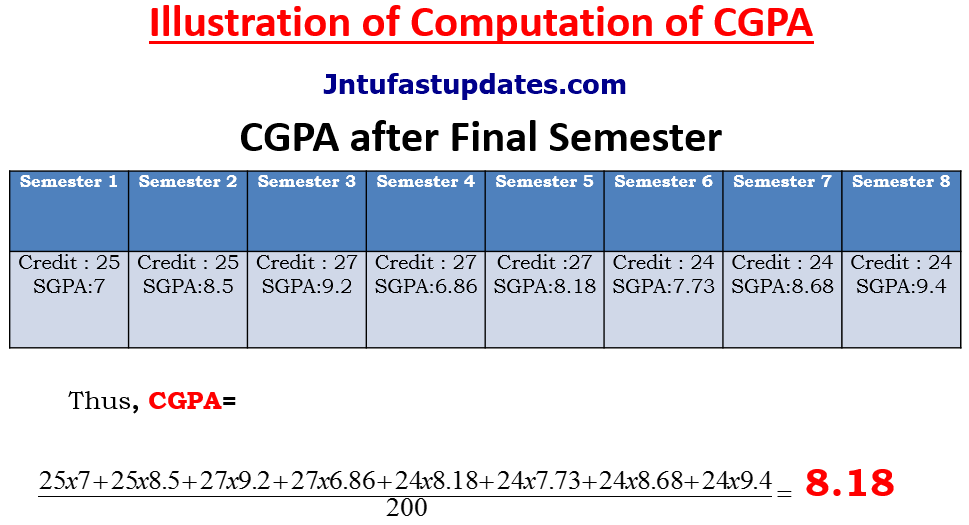
At its core, a 6th sem cgpa calculator uses grade points and credit weights to compute a weighted average. The most common method follows these steps:
- Convert letter grades or percentage marks into grade points using the institution’s grade-to-point scale.
- Multiply each course’s grade point by its credit hours to obtain quality points.
- Sum the quality points for the 6th semester and previous semesters as defined by the CGPA formula.
- Divide the total quality points by the total attempted credits to yield the CGPA.
- Apply rounding rules consistent with institutional policy.
Typical formula
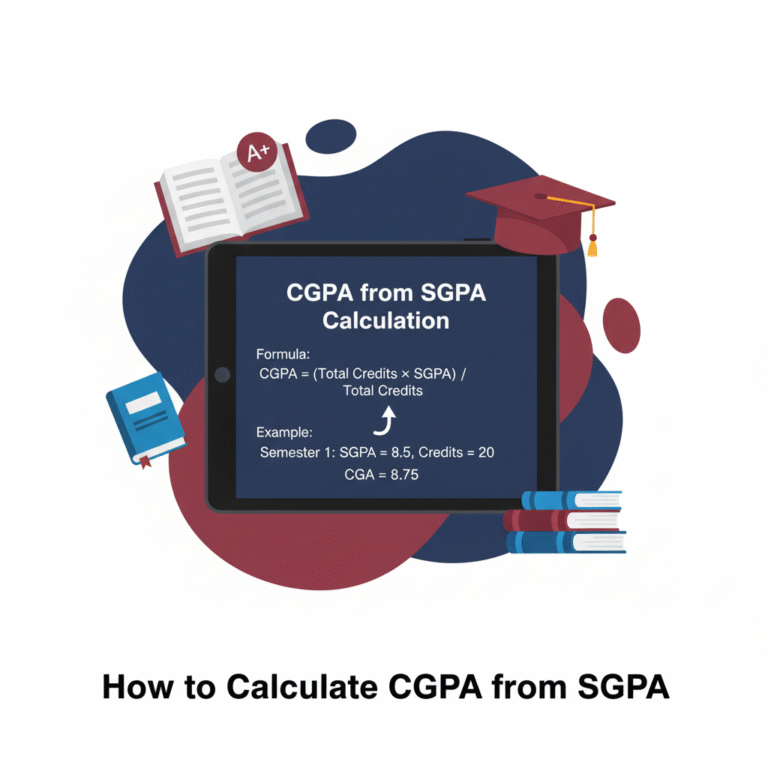
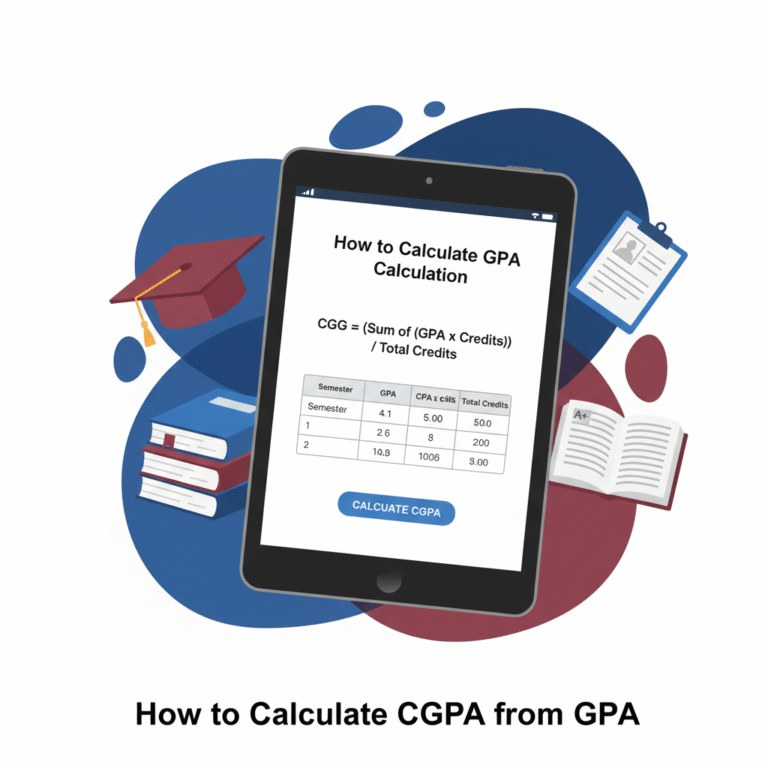
CGPA = (Σ (Grade Point_i × Credit_i)) / (Σ Credit_i)
A 6th sem cgpa calculator automates this arithmetic while honoring rules such as failing grade policies, repeat course adjustments, and elective-credit handling. More advanced calculators may permit scenario modeling—for example, “If I get an A in Course X and a B in Course Y, my final CGPA will be…”
Implementation considerations
- Input validation: Ensuring grades and credits entered by users match permitted formats.
- Grade-scale mapping: Supporting multiple grading schemas (e.g., 10-point, 4-point).
- Rounding rules: Configurable rounding precision to align with institutional transcripts.
- Security and privacy: Handling personal grade data securely, typically via university single sign-on.
- Accessibility: Ensuring the calculator is usable across devices and by students with disabilities.
Institutional Policies and the Role of Regulation
Institutions and accreditation bodies often prescribe the grade-point conversion and rounding norms. A 6th sem cgpa calculator must comply with these rules, which are part of a wider policy framework that governs assessment validity and fairness.
Policy framework alignment
- Accreditation standards: Many national higher-education regulators require a clear and documented CGPA computation method. This protects students and supports external audits.
- Affiliated college consistency: In regions where central universities affiliate multiple colleges, standardized calculators help maintain parity in student assessment.
- Transparency measures: Publishing the calculation rules alongside the calculator ensures trust and minimizes disputes over grade computation.
These policy considerations tie into broader state-level educational reforms and initiatives aimed at improving student assessment and post-graduate employability.
Regional and State-Level Impact
Although a 6th sem cgpa calculator is primarily a technical and administrative tool, its effects ripple across regional education ecosystems. States and educational boards use aggregated CGPA data to inform policy interventions and to measure the effectiveness of programs.
Educational planning and analytics
- Performance mapping: State authorities can identify districts or institutions with consistently low CGPA trends and target resources accordingly.
- Scholarship allocation: CGPA thresholds often determine eligibility for state-sponsored scholarships and fellowships.
- Workforce readiness: Employers across regions frequently use CGPA as a screening metric; hence, accurate calculators indirectly shape hiring patterns.
Regional digital infrastructure
Investment in digital educational infrastructure—student portals, centralized grade repositories, and a 6th sem cgpa calculator—can be part of regional development initiatives. Such tools help narrow the digital divide when accompanied by training and outreach.
Success Stories: How Calculators Made a Difference
Across diverse institutions, the introduction of a reliable 6th sem cgpa calculator has led to measurable benefits:
- Reduced administrative workload: Registrars report fewer calculation errors and more streamlined transcript generation.
- Improved student planning: Students using calculators to model outcomes often make more strategic course choices and devote extra effort to high-credit courses that impact CGPA more.
- Transparent scholarship decisions: Scholarship committees benefit from consistent and auditable CGPA reports when deciding awards.
- Enhanced mental well-being: Predictability in grade outcomes reduces speculative anxiety among students nearing graduation.
One illustrative example: a university that introduced an interactive 6th sem cgpa calculator alongside academic counseling saw a rise in graduation rates and placement conversion, because students could more readily identify priority courses to improve their overall academic profile.
Challenges and Limitations
Despite clear benefits, a 6th sem cgpa calculator is not a panacea. Key challenges include:
Data quality and correctness
Incorrect grade inputs, mismatched credit definitions, or usage of inappropriate grade scales can produce misleading CGPA outputs. Validators and institutional integrations are necessary to maintain data fidelity.
Overreliance on numeric metrics
When students and employers focus too heavily on CGPA, nuanced qualities like soft skills, internships, or project work may be undervalued. Calculators should be framed as one of several evaluative tools.
Equity concerns
Institutions must ensure that calculators and accompanying guidance do not advantage students who have greater access to digital devices or private tutoring. Regional impact assessments and outreach programs can help mitigate these disparities.
Technical and privacy issues
Implementations must safeguard student data against unauthorized access and comply with relevant privacy regulations. Poorly secured calculators can put sensitive academic records at risk.
Comparisons: CGPA Calculators vs. Other Assessment Tools
The 6th sem cgpa calculator occupies a specific niche among academic assessment instruments. Comparing it to alternative or complementary tools offers perspective.
CGPA calculator vs. percentage-based reporting
- CGPA is normalized across courses and credit weights; a percentage system is course-specific.
- 6th sem cgpa calculator provides comparability across disciplines, whereas percentage reporting may not reflect credit-weighted significance.
CGPA calculator vs. rank-based metrics
- Rank-based systems order students relative to peers but obscure absolute performance.
- A CGPA calculator gives absolute performance metrics, which are useful for scholarships and external applications.
CGPA calculator vs. competency-based assessments
- Competency-based systems evaluate mastery of specific skills; calculators reflect graded outcomes.
- The two approaches can be complementary: calculators show cumulative achievement while competency assessments highlight specific capabilities.
CGPA calculator vs. predictive analytics tools
- Advanced predictive systems use historical data, attendance, and assignment patterns to forecast outcomes.
- A 6th sem cgpa calculator provides deterministic arithmetic scenarios; predictive analytics add probabilistic forecasting that can be layered on top.
Designing an Effective 6th Sem CGPA Calculator: Best Practices
For institutions or developers building a 6th sem cgpa calculator, these best practices ensure usefulness and trustworthiness:
- Align with institutional policy: Embed the exact grade-to-point mapping and rounding rules used on official transcripts.
- Provide clear instructions: Explain assumptions—e.g., whether repeat courses replace previous grades or not.
- Offer scenario modeling: Let students input projected grades to see how different outcomes affect CGPA.
- Implement input validation: Prevent impossible grade entries and enforce credit totals.
- Ensure accessibility: Design for mobile devices and adhere to accessibility standards for visually impaired students.
- Protect privacy: Use secure authentication and encryption for any stored or transmitted grade data.
- Log and audit: Maintain calculation logs for institutional auditability without exposing personal information publicly.
Following these practices helps embed a 6th sem cgpa calculator within a campus ecosystem while supporting transparency and student success.
Use Cases: Who Benefits and How
Different stakeholders gain distinct value from a 6th sem cgpa calculator:
- Students: Immediate projections for GPA planning, scholarship eligibility checks, and placement preparedness.
- Academic advisors: Scenario analysis to guide students on course prioritization or repeat decisions.
- Career services: Quick verification of CGPA thresholds for employer shortlists and internship selection.
- Administrators: Standardized outputs for transcripts, merit lists, and accreditation reporting.
- Policy makers: Aggregated CGPA data to monitor system-wide academic performance and target interventions.
Integration with Campus Systems and Third-Party Services
A well-integrated 6th sem cgpa calculator can plug into learning management systems (LMS), student information systems (SIS), and career portals. Integration benefits include:
- Automated grade retrieval, reducing user input errors.
- One-click transcript generation with consistent rounding rules.
- Exportable reports for state education departments and accreditation bodies.
Third-party integrations must be carefully governed through data-sharing agreements that uphold student privacy and institutional control.
Ethical Considerations
When deploying a 6th sem cgpa calculator, ethical considerations include:
- Transparency: Clearly communicate how the calculation is performed and what assumptions are made.
- Fairness: Avoid algorithmic rules that unintentionally disadvantage specific student groups.
- Consent: Obtain student consent for any use of their academic data beyond the immediate calculation.
- Non-discrimination: Ensure calculator outputs are not used as the sole basis for high-stakes decisions without human oversight.
Ethical deployment strengthens trust in institutionally provided calculators and helps protect student rights.
Future Prospects: Where CGPA Calculators Are Heading
Looking ahead, the 6th sem cgpa calculator will likely evolve in several directions:
Predictive and prescriptive analytics
Future calculators will combine arithmetic projections with machine-learning models that predict grade likelihoods and prescribe actions—study plans, tutoring suggestions, or course retakes that offer the most CGPA improvement.
Integration with competency frameworks
Calculators may be augmented to report CGPA alongside competency badges or micro-credentials, providing a fuller picture of student capabilities.
Greater interoperability
Standardized APIs will allow calculators to interoperate across universities, enabling students transferring between institutions to carry reliable cumulative metrics.
Policy-driven dashboards
Regulators and state-level education departments will use aggregated CGPA data from calculators to design targeted interventions, scholarships, and capacity-building programs—linking the 6th sem cgpa calculator to wider policy frameworks and regional development goals.
Practical Guide: How to Use a 6th Sem CGPA Calculator Effectively
Follow these steps to get reliable results from a 6th sem cgpa calculator:
- Confirm the grade-to-point scale used by your institution.
- Gather official credit information for each course.
- Enter existing semester grade points accurately.
- For projections, input realistic expected grades based on past performance.
- Review rounding rules—some calculators round to two decimals, others to three.
- Use scenario modeling to understand attainable improvements and prioritize effort accordingly.
Remember that calculators are planning tools, not guarantees. Use them to inform decisions, consult advisors for interpretation, and complement numeric insight with skill development.
Success Metrics: Measuring the Impact of a 6th Sem CGPA Calculator
Institutions can measure success by tracking:
- Reduction in grade calculation disputes.
- Time saved by registrars and advisors.
- Improvement in student outcomes—higher placement conversion or scholarship uptake.
- Increased transparency and fewer transcript corrections.
Qualitative metrics—student satisfaction and advisor trust—are equally important and often reveal adoption barriers or training needs.
Recommendations for Institutions and Policy Makers
To maximize the benefits of a 6th sem cgpa calculator, institutions and policy makers should:
- Standardize CGPA computation rules and publish them prominently.
- Invest in accessible, secure digital tools integrated with SIS and LMS systems.
- Provide student training sessions and FAQs to demystify CGPA computations.
- Use aggregated CGPA data ethically to target scholarships, remediation, and capacity building.
- Monitor and audit calculators regularly to ensure correctness and fairness.
These recommendations align calculators with broader educational goals—equity, transparency, and student success.
Frequently Asked Question
Final Thoughts
The 6th sem cgpa calculator is more than an arithmetic convenience; it is a planning instrument, an administrative simplifier, and a data source that feeds into broader educational strategies. When implemented with transparency, security, and alignment to institutional policy, such calculators empower students, support advisors, and provide actionable insights for policymakers. As digital infrastructure and analytics mature, the 6th sem cgpa calculator will likely play an even more integrated role—pairing arithmetic certainty with predictive intelligence and competency mapping to support holistic student success.
For students approaching the end of their program, the calculator is a compass: use it wisely, verify outputs with official rules, and complement its guidance with mentorship and skill-building. For institutions and regional authorities, treat calculator outputs as valuable indicators that, with proper governance, can help drive targeted interventions, scholarship schemes, and educational improvements that benefit broad swathes of learners.