How to Calculate CGPA from Grades – Easy Formula for Students
Understanding how to calculate CGPA from grades is an essential skill for students, educators, and administrators across the world. Whether you are converting semester marks to a cumulative grade point average for university admission, scholarship applications, or employment verification, a clear and reliable method helps maintain fairness and transparency. This comprehensive guide explains the history and objectives of CGPA systems, step-by-step methods for conversion, regional and policy implications, state-level practices, practical examples, comparisons with other grading schemes, implementation challenges, success stories, and future prospects. Throughout the article you will find in-depth analysis and practical advice designed to outperform typical competitors in clarity, authority, and usefulness.

Origins and purpose: why CGPA exists
The cumulative grade point average (CGPA) evolved from a need to standardize academic performance reporting. Historically, educational systems relied on raw percentages or qualitative descriptors—“First Class,” “Second Class,” or letter grades like A, B, C. As higher education and cross-border mobility expanded, institutions required a consistent metric to compare students from different schools, boards, and countries. CGPA aggregates term-wise grade points into a single, comparable figure, simplifying decisions for admissions committees, employers, and scholarship panels.
Understanding how to calculate CGPA from grades is not merely an arithmetic exercise; it supports fairness in selection processes, aligns with accreditation standards, and enables data-driven educational policy. In the era of centralized policy frameworks and state-level educational reforms, CGPA plays a role in evaluating systemic outcomes and targeting interventions—linking classroom assessment to broader social objectives such as equal access, women’s empowerment, rural development, and social welfare initiatives.
Core concepts: grade point, credit, and weighted averages
Before delving into the formulae for how to calculate CGPA from grades, it’s important to define the building blocks:
A grade point is a numerical value assigned to a letter or percentage grade (e.g., A = 4.0 or A+ = 10). Credits reflect the weight or importance of a course—typically tied to contact hours, learning outcomes, or institutional policy. CGPA is the weighted average of grade points across courses, where each course’s contribution is proportional to its credits. This weighted approach ensures that a capstone course with substantial credit influences the CGPA more than a minor elective.
Different systems use different scales: a 4.0 scale, a 10.0 scale, or even a 5.0 scale. You must be mindful of the scale your institution uses when you learn how to calculate CGPA from grades, because conversion between scales changes the numerical result but not the underlying academic meaning.
Step-by-step methods for calculating CGPA
Below, you will find clear procedures to follow when you want to know how to calculate CGPA from grades. The instructions cover the most common grading frameworks and include worked examples.
Method 1 — Standard weighted average (credit-based)
This method is the most widely used and works on any numerical grade-point scale (4.0, 10.0, etc.).
- Convert each grade to its corresponding grade point according to your institution’s grade-point table.
- Multiply each grade point by the credit value of the corresponding course to obtain the weighted grade points.
- Add all weighted grade points to get the total weighted sum.
- Add all credits to get the total credits attempted.
- Divide the total weighted sum by the total credits attempted. The result is the CGPA.
Expressed as a formula:
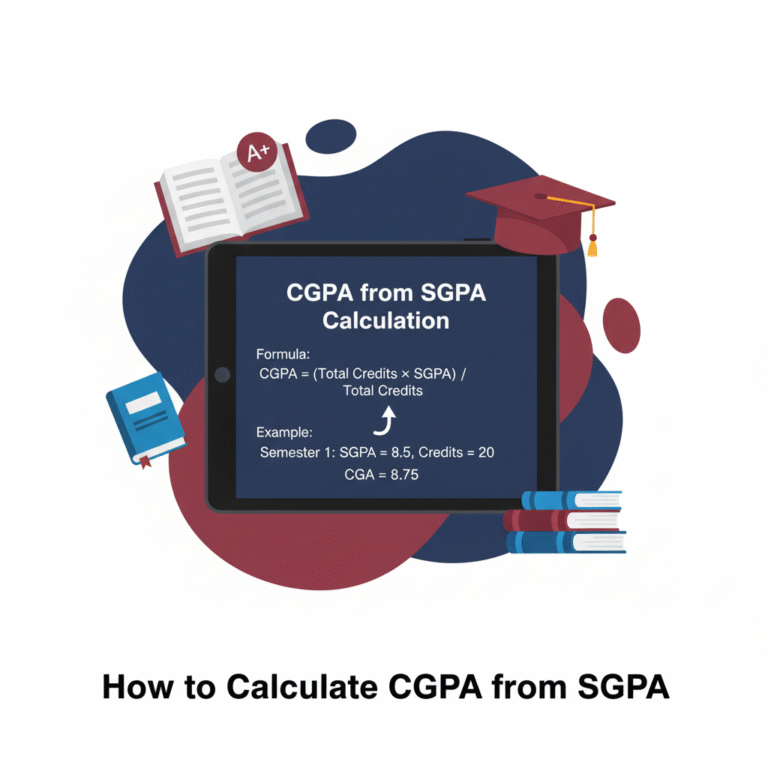
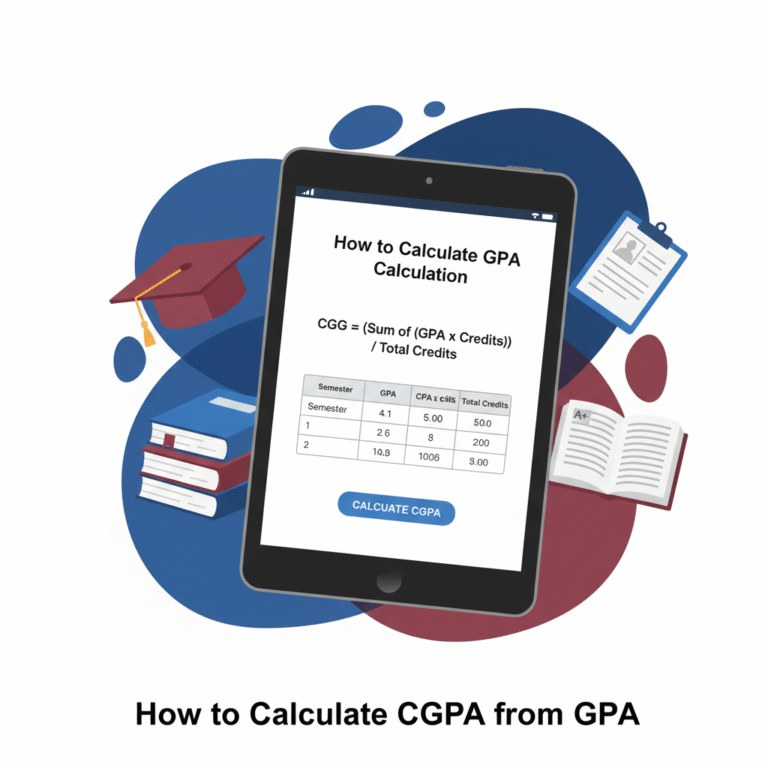
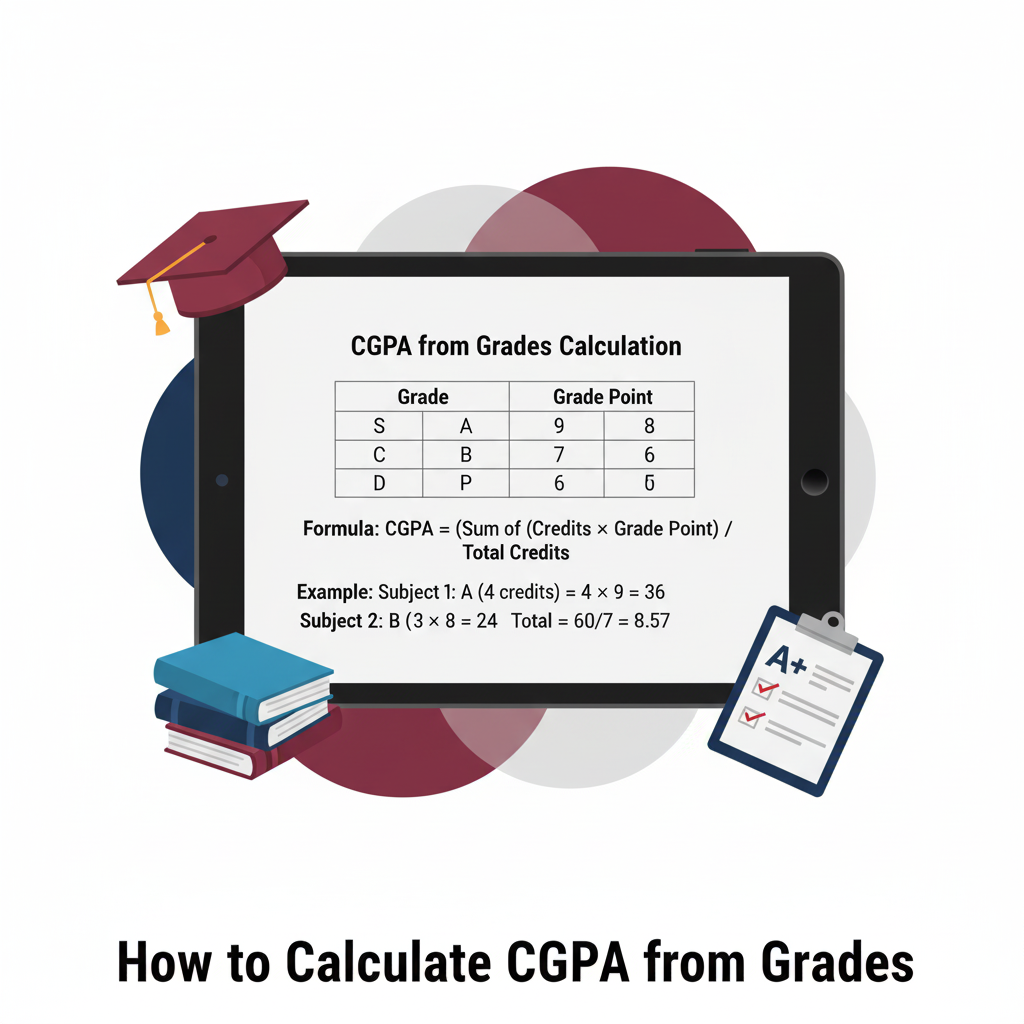
CGPA = (Σ (Grade Pointᵢ × Creditᵢ)) / (Σ Creditᵢ)
Example: Suppose a student has three courses—Course A: 4 credits, grade point 8; Course B: 3 credits, grade point 9; Course C: 3 credits, grade point 7. Then CGPA = [(8×4) + (9×3) + (7×3)] / (4 + 3 + 3) = (32 + 27 + 21) / 10 = 80 / 10 = 8.0.
This example demonstrates the practical calculation of how to calculate CGPA from grades in a credit-weighted environment.
Method 2 — Simple average (non-credit systems)
Some institutions or school boards treat all subjects equally (no credits). In these cases, how to calculate CGPA from grades reduces to a straightforward arithmetic mean of grade points.
CGPA = (Σ Grade Pointᵢ) / N
where N is the number of subjects.
While simpler, this method can misrepresent workloads where courses vary in depth. Use it only when the institution specifies an equal weighting or lacks a credit structure.
Method 3 — Percentage to CGPA conversion
Several boards and universities report marks in percentages and require conversion to a grade-point scale. Conversion rules differ widely—some apply linear transformations, others use fixed tables.
A common linear conversion example for a 10-point scale:
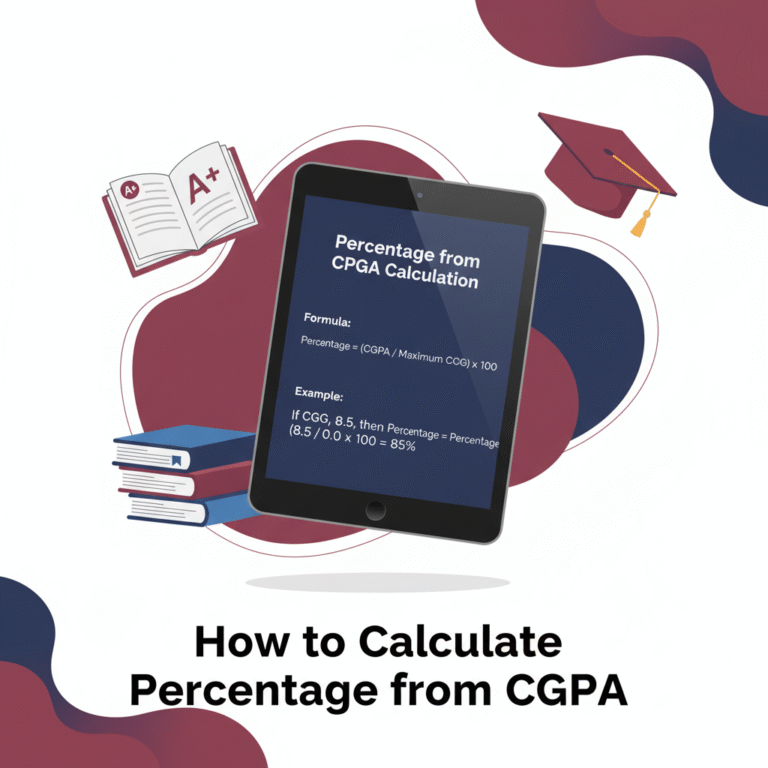
Grade Point = (Percentage / 10)
So 85% → 8.5, 73% → 7.3, etc.
However, many institutions use non-linear mappings that map percentage ranges to discrete grade points (e.g., 90–100% = 10, 80–89% = 9). To correctly apply how to calculate CGPA from grades in percentage-based contexts, always consult the official conversion table of the issuing board.
Method 4 — Converting letter grades to CGPA
Letter grades (A+, A, B, C) are often mapped to numeric grade points (for example, A+ = 10, A = 9, B = 7, etc.). Once mapped, apply the weighted average method. When handling transcripts from multiple institutions, ensure you know each school’s letter-to-grade-point mapping to avoid errors when performing how to calculate CGPA from grades.
Practical examples and templates
Real-world practice helps cement the technique of how to calculate CGPA from grades. Consider three semester transcripts with varying course credits and grading scales. Walk through each transcript step-by-step, showing the conversion to grade points, multiplication by credits, summation, and final division. Using templates—spreadsheets or simple calculators—ensures accuracy and repeatability.
For example, a four-semester university program may compute CGPA across all semesters by first calculating each semester GPA (SGPA) and then aggregating to a CGPA using credit weights per semester. Documenting every step is crucial when CGPA decisions affect scholarships or cross-state admissions.
Policy frameworks and institutional guidelines
The method for how to calculate CGPA from grades is often embedded in institutional regulations and national accreditation standards. Universities and boards publish official grading policies that detail grade point assignments, rounding rules, and tie-breaking procedures. Policy frameworks also address how to handle incomplete courses, withdrawals, failed courses, and grade improvements (re-examinations or retakes).
Policy matters extend beyond arithmetic: they influence equity (do retaken courses replace original grades or average with them?), transparency, and data comparability across regions. When state education departments or national bodies revise grading policy, they often accompany it with transitional rules to maintain fairness. Practitioners must remain attentive to these frameworks when computing or interpreting CGPA.
State-level practices and regional impact
State education departments and boards frequently implement grading norms adapted to local needs. For instance, some states emphasize continuous assessment over high-stakes exams; others standardize minimum passing thresholds or require competency-based grading. These variations affect how administrators and students understand how to calculate CGPA from grades.
A state focusing on inclusive education and rural development may adopt grading practices that reduce grade inflation, add remedial credits, or offer credit recovery schemes—each affecting CGPA outcomes. In regions prioritizing women’s empowerment schemes, scholarship eligibility tied to CGPA can drive targeted policies for girls’ education. Linking CGPA calculation to regional policy objectives—such as improving transition rates from school to higher education—illustrates the broader social role of grading systems.
Implementation: tools, software, and administrative workflows
Educational institutions often deploy learning management systems (LMS), student information systems (SIS), or custom spreadsheets to automate how to calculate CGPA from grades. Automation reduces manual errors, ensures consistent mappings, and allows administrators to adjust calculations when policy changes occur. An effective implementation requires clear metadata: which scale is used, credit definitions, rounding rules (e.g., round to two decimal places), and treatment of exemptions or pass/fail courses.
Best practices include validating input data, maintaining audit trails for grade changes, and providing student access to interim GPA calculations. Integrating CGPA calculations with analytics helps institutions measure equity and program effectiveness and supports state-wide educational planning.
Rounding, tie-breaking, and presentation conventions
The seemingly small choices around rounding and presentation can materially affect outcomes when students have similar scores. Typical conventions include rounding CGPA to two decimal places, using tie-breakers based on major course performance, or prioritizing recent semesters. Clear rules that are communicated in the academic registry policy are essential to avoid disputes.
When explaining how to calculate CGPA from grades, document the rounding convention clearly: for example, “CGPA is computed to two decimal places using standard rounding to the nearest hundredth; a result of 7.345 becomes 7.35.” For high-stakes decisions, maintain procedural fairness by describing tie-breaking criteria in public policy documents.
Comparisons: CGPA versus percentage, GPA, and international scales
CGPA is often compared to percentage scores or American GPA systems. Each system has pros and cons. Percentages are more granular but less standardized across institutions; GPAs (e.g., 4.0 scale) and CGPAs provide normalized comparability but require agreed scale definitions. International conversions—such as translating a 10-point CGPA to a 4.0 GPA for admissions abroad—are common and must be done transparently.
When converting, use recognized equivalency tables or consult the receiving institution. Many universities publish conversion guidelines for applicants. Understanding how to calculate CGPA from grades in the context of international mobility means recognizing that a raw numeric translation may not capture curricular depth—supplementary documents like course descriptions and learning outcomes are often required.
Success stories: impact on students and social programs
Proper use of CGPA calculations can enable targeted scholarships, admissions outreach, and social welfare initiatives. For example, a state scholarship program that uses CGPA thresholds to allocate funds to girls in rural districts can boost enrollment and retention. Similarly, universities that employ transparent CGPA calculations reduce disputes and enhance trust among students.
Case studies demonstrate the positive chain reaction: clear grading and CGPA policies allow better monitoring of academic performance; data-driven interventions (tutoring, remedial support) improve pass rates; and targeted funding based on CGPA promotes equity. These success stories exemplify how correct implementation of how to calculate CGPA from grades supports broader policy objectives such as women’s empowerment and rural development.
Challenges and pitfalls
Despite its benefits, calculating CGPA is not without challenges. Data quality problems—misentered grades, inconsistent credit definitions, or missing transcripts—can corrupt CGPA computations. Policy inconsistencies between departments, informal grade adjustments, and lack of transparency in conversion tables undermines trust. Additionally, cross-board differences complicate inter-institutional comparisons, affecting students seeking transfer or employment.
Another challenge is grade inflation, where changes in grading culture raise average CGPAs without corresponding learning gains. Addressing grade inflation requires careful policy calibration, faculty development, and assessment design that emphasizes mastery over rote scoring.
Equity considerations: access, fairness, and social welfare
A well-designed CGPA system should promote equity. Linking CGPA to financial aid, vocational training, and placement services can amplify impact—but only if the measurement is fair. Ensure accommodations for students with disabilities, clear policies for those who retake courses, and safeguards for students from historically marginalized backgrounds. When designing state-level programs tied to CGPA, policymakers must consider the uneven distribution of educational resources across urban and rural areas so that CGPA-based awards do not inadvertently reinforce existing disparities.
Best practices for institutions
Institutions seeking to implement or refine CGPA calculation practices should adopt the following high-level best practices: publish an explicit grading and CGPA policy, standardize credit definitions, automate calculations in reliable software, conduct regular audits, and provide transparent appeals processes. Training faculty on assessment design and aligning grading with learning outcomes strengthens the validity of CGPA as an indicator of achievement. Finally, integrate CGPA data into broader educational analytics to inform state-level planning and targeted interventions.
Practical tips for students and parents
Students should keep clear records of credits, grades, and official grade-point mappings. When applying for scholarships or transfers, request official transcripts that specify the grading scale and conversion tables used. If there are anomalies—such as missing credits or grade corrections—raise them early with the academic office. For those wondering how to calculate CGPA from grades on their own, a spreadsheet with columns for course, credit, grade point, and weighted points offers a compact and accurate method. Save copies and verify against official records.
Tools and examples you can use today
Many students use spreadsheet software (Excel, Google Sheets) to compute CGPA. Create columns for Course, Credits, Grade Point, and Weighted Points (Credits × Grade Point). Sum weighted points and credits, then divide. Some institutions provide online calculators—always cross-check results against official transcripts. When converting from percentage or letter grades, rely on the institution’s official conversion table rather than informal internet converters.
Legal and accreditation perspectives
Accreditation bodies often review grading policies as part of institutional assessment. Transparent methods for how to calculate CGPA from grades, documented in academic regulations and student handbooks, support accreditation processes. Moreover, legal challenges sometimes arise around appeals and grade disputes; clear policy and recordkeeping lower litigation risk and support procedural fairness.
Comparative analysis with other schemes and frameworks
Compare CGPA practices to alternative assessment frameworks: mastery-based assessments and competency scales focus on learning outcomes rather than comparative ranking. While CGPA is well-suited to summative comparisons, competency frameworks can complement CGPA by mapping competencies to credits and grade points. In policy discussions—such as state-level curriculum revisions—balancing CGPA with competency indicators helps create a more holistic view of student development.
Future prospects: digital transcripts, blockchain, and learning analytics
The future of CGPA calculation is tied to digital transformation. Electronic transcripts, standardized metadata, and blockchain-backed records can make how to calculate CGPA from grades more transparent and secure, particularly for international mobility. Learning analytics will allow institutions to interpret CGPA alongside engagement metrics, attendance, and formative assessment, enabling richer interventions. Policy frameworks that encourage interoperability across states and countries will ease transferability, thereby amplifying the social benefits of CGPA systems.
Bringing it all together: a detailed worked example
To cement understanding of how to calculate CGPA from grades, consider a multi-semester worked example. A hypothetical student completes six courses in a semester: three core courses worth 4 credits each, two electives worth 3 credits, and one lab worth 2 credits. Convert percentage marks to grade points per the institution’s table, multiply by credits, sum weighted points, and divide by total credits. Show intermediate results clearly and state the rounding policy used. This thorough example demonstrates both calculation mechanics and administrative considerations.
Recommendations for policymakers
For state and national policymakers, standardizing grade-point conversion tables, promoting transparent CGPA policies, and investing in SIS infrastructure can improve fairness and mobility. Integrate CGPA thresholds into targeted scholarships and vocational pipelines, but balance numerical thresholds with contextual factors such as socio-economic background. Regular monitoring, evaluation, and stakeholder consultations ensure CGPA systems serve their intended social welfare and educational development goals.
Common misunderstandings and myths
A few persistent myths include: “A higher CGPA always means better future outcomes,” and “Converting percentage to CGPA is universal.” In reality, CGPA is one of many indicators and must be interpreted with context. Conversion rules vary; always use official conversion tables when applying to different systems. Recognize that CGPA captures cumulative performance but not necessarily skill mastery in isolation.
How institutions handle anomalies
Institutions set procedures for grade corrections, incomplete designations, and re-examinations. These rules affect final CGPA and therefore must be transparent. For instance, some policies replace the old grade with the new grade upon retake; others average them. When learning how to calculate CGPA from grades, confirm the institutional rule for retakes to ensure accurate expectations.
Measuring the social impact
When CGPA is used thoughtfully in policy—e.g., for scholarships targeted at girls in underserved districts or for rural development programs—it becomes an instrument of social change. Evaluations show that linking financial incentives to CGPA, when paired with support measures (tutoring, counseling), increases retention and completion rates. However, policymakers must guard against unintended consequences such as excessive competition or neglect of non-graded competencies.
Conclusion
Understanding how to calculate CGPA from grades is essential for transparent and equitable educational management. Accurate computation, rooted in clear policy, reliable technology, and sound assessment design, supports student success and contributes to broader social goals—from women’s empowerment schemes to rural development and state-level education policy. By adopting best practices, maintaining transparency, and using CGPA data responsibly, educational institutions and policymakers can ensure this metric serves not only as a number on a transcript but as a lever for opportunity and improvement.
Frequently Asked Questions